
Choosing the Right Dome Size: A Practical Guide for Resort Owners
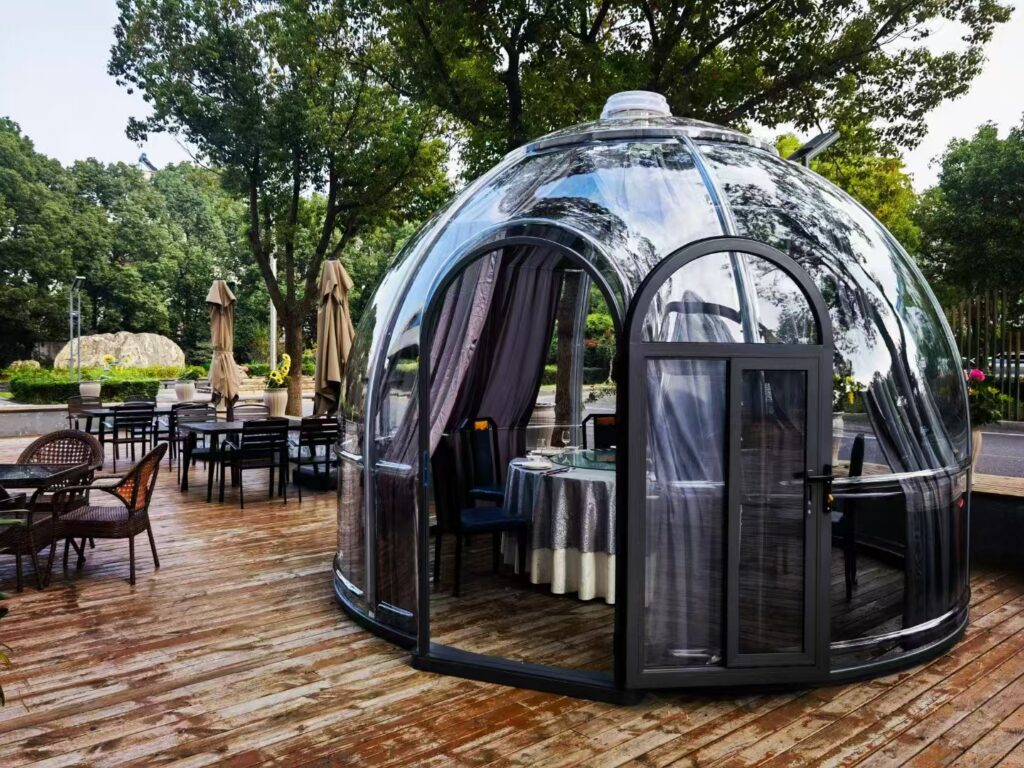
Size drives everything downstream: guest experience, site density and freight cost. Get it wrong and you either waste land or waste freight — and both mistakes are expensive to reverse once the deck is poured. This guide walks through our range model by model, with the published dimensions, so resort owners can match a dome size to the experience they intend to sell.
One number governs everything that follows: the diameter, because the usable floor of a dome is a circle rather than a rectangle. Two rooms with the same floor area do not live the same way when one of them is round.
Size-by-Size: 2.7 m to 6.2 m
Five round models make up the Star Series, and the spread between the smallest and largest is wider than most buyers expect:
| Model | Diameter × height | Floor area | Capacity | Net weight | Assembly |
|---|---|---|---|---|---|
| ZH270 | Φ2.7 m × H2.7 m | 5.7 m² | 2–4 persons | ≈135 kg | 2 workers × 2 hours |
| ZH350 | Φ3.5 m × H2.8 m | 9.6 m² | 6–8 persons | ≈160 kg | 2–3 workers × 3 hours |
| ZH400 | Φ4.0 m × H3 m | 12.5 m² | 8–10 persons | ≈220 kg | 3 workers × 3–5 hours |
| ZH510 | Φ5.1 m × H3.2 m | 20.4 m² | 16–18 persons | ≈295 kg | 3–4 workers × 3–5 hours |
| ZH620 | Φ6.2 m × H3.5 m | 30.17 m² | 20–22 persons | ≈400 kg | 4–5 workers × 5–7 hours |
2.7 m and 3.5 m Domes: Compact Units for Volume Sites
At 5.7 m² and 9.6 m², the two smallest round models are compact glamping units — a bed, a side table and a view, with a door height of 2 m across the whole range. They are the highest-density option for shipping (40 and 30 sets per 40HQ respectively) and the lightest to handle on site at roughly 135 kg and 160 kg. Where a site has many plots and a mid-range price point, a cluster of compact domes can outperform fewer large units on occupancy, because each plot earns its own nightly rate.
4 m Domes: The Glamping Sweet Spot
The 4 m round dome is the most popular export model for a reason. Its 12.5 m² floor gives noticeably more room than the 3.5 m for the same container density — both load 30 sets per 40HQ — and at around 220 kg the shell is still light enough for a simple wood-deck foundation and a three-person crew. For most operators starting their first dome site, 4 m is the safest first buy.
5.1 m and 6.2 m Domes: Family and Lounge Layouts
Step up to 5.1 m (20.4 m²) or 6.2 m (30.17 m²) and the dome opens the door to lounge layouts, family bookings and dining experiences. A 6.2 m unit can host a sofa area, a dining table or a freestanding tub — the kind of interior that justifies a premium nightly rate. The trade-offs are a heavier frame (roughly 295 kg and 400 kg), a larger footprint, a longer build (five to seven hours with four to five people on the 6.2 m) and lower container density at 24 and 16 sets per 40HQ.
Elliptical Capsules and Spliced Combinations
Not every site suits a circle. Our Moon Series capsules offer a long, low footprint that follows plot shapes and improves wind behaviour on exposed sites. Spliced combination units join two or three round modules into larger suites or shared lounges — useful when the resort needs a bigger room without ordering a bespoke build. The trade-off is that a spliced unit has more than one shell to assemble, so plan the sum of those build times plus the connection between modules.
The Wider Range, by Floor Area
If a circular footprint is not what your plots want, the same engineering is available in other shapes — and the floor areas climb well past the round range:
| Shape | Models and floor area |
|---|---|
| Oval Star Capsule | ZH270X365 8.28 m² · ZH270X460 10.85 m² · ZH270X650 15.98 m² · ZH0400 20.1 m² · ZH0400L 27.7 m² |
| Transparent Space Capsule | ZH365X650 22.15 m² · ZH365X840 29.09 m² · ZH460X650 28.33 m² · ZH460X840 37.07 m² |
| Square Round Star Room | ZH365X365 11.75 m² · ZH365X460 15.22 m² · ZH460X460 19.59 m² |
| Spliced Star Room | ZH270+ZH350 15.3 m² · ZH270+ZH400 18.2 m² · ZH270+ZH510 26.1 m² · ZH270+ZH620 35.87 m² · ZH270+ZH350+ZH620 45.47 m² |
The useful comparison is not floor area alone. An oval capsule with 20.1 m² and a 6.2 m round dome with 30.17 m² both support premium layouts, but the capsule presents a narrower face to the wind and fits a long, thin plot, while the round dome gives a wider panoramic view. Which is better depends on the plot you actually own — which is why we ask for a site plan before recommending a size.
Guest Experience vs Site Density
Every square metre of floor area has two prices: what it costs to build, and what it can earn. A 4 m dome keeps guest experience high while keeping site density reasonable — more units on the same land, each still selling at a glamping-grade rate. A 6.2 m dome earns more per night but consumes more land, so the revenue-per-square-metre comparison is usually closer than the nightly-rate comparison suggests.
There is a second density constraint that catches owners out: the space between domes. Deck size, access paths, service routes and the view lines between plots all consume land, and a dome that fills its plot leaves nowhere to work. Our recommendation: pick the smallest dome that delivers the experience tier you want to sell, then pilot it. Booking data will tell you whether to upgrade, not the brochure.
Container Loading: How Size Affects Landed Cost
Freight is charged per container, not per dome, so size has a direct effect on landed cost. The published density runs from 40 sets of the 2.7 m model per 40HQ down to 16 sets of the 6.2 m — at scale, that difference can halve your freight per unit. Please confirm the final loading quantity with us for your specific order. The full loading maths for every model type, plus how to estimate your shipping cost, is covered in our 40HQ container loading guide.
How to Pilot Before Scaling
No spreadsheet replaces real booking data. We recommend piloting a single model — one to three units — on a representative plot, gathering occupancy and rate data for a season, then scaling. Every STAR DOME project includes free layout advice from our engineering team, so the pilot is designed around your site and your market from day one.
Run the pilot with the same model you intend to scale on. A pilot built with a 4 m unit tells you how a 4 m unit books; it tells you much less about a 6.2 m unit two price tiers higher. When you are ready to size the budget, our dome house price breakdown explains exactly what drives the cost of each size.
FAQ
What size dome house is best for glamping?
For most operators, the 4 m round dome is the best first buy: 12.5 m² of floor area fits a queen bed and a small lounge, the shell weighs around 220 kg so it works on a simple deck foundation, and it packs 30 sets per 40HQ container for low freight per unit.
What is the difference between a 4 m and 6.2 m dome?
A 4 m dome offers 12.5 m² and works as a compact bedroom unit; a 6.2 m dome offers 30.17 m² and adds space for lounge layouts, dining and family bookings. The 6.2 m unit earns more per night but uses more land, takes longer to build and ships 16 sets per container against 30.
Can dome houses be joined together?
Yes. Spliced combination units join two or three round modules into larger suites or shared lounges — from 15.3 m² for a two-module unit up to 45.47 m² for a three-module layout — giving resorts room variety without bespoke manufacturing.
Should I start my dome resort with one size or several?
Start with one model as a pilot, gather a season of booking data, then scale. Mixing models makes sense later — round domes for premium views, capsules for sheltered plots, combinations for larger suites.
Do I need a bigger dome for a bathroom?
It depends on the layout you are selling. Compact units in the 2.7 m to 3.5 m range are typically sleeping pods, while the 4 m floor area of 12.5 m² and above is where an en-suite or a separated wet area becomes practical. Tell us the layout you have in mind and we will confirm which sizes can carry it.
Ready to start your dome project?
Talk to our engineers or download the full product catalog first.
Related Posts
 13
Oct 2026
13
Oct 2026
PC Dome vs PVC and Canvas Glamping Tents: A Buyer’s Material Guide
PC dome vs PVC and canvas glamping tents: how the shell material decides lifespan, clarity, weather resistance and what you can build.
View More 29
Sep 2026
29
Sep 2026
Dome House for Backyard Glamping: How to Plan Your First Unit
Dome house for backyard glamping, planned properly: right size, level base, power, heating and what one unit needs before delivery day.
View More