
How Many 4m Dome Houses Fit in a 40HQ Container? Shipping Guide
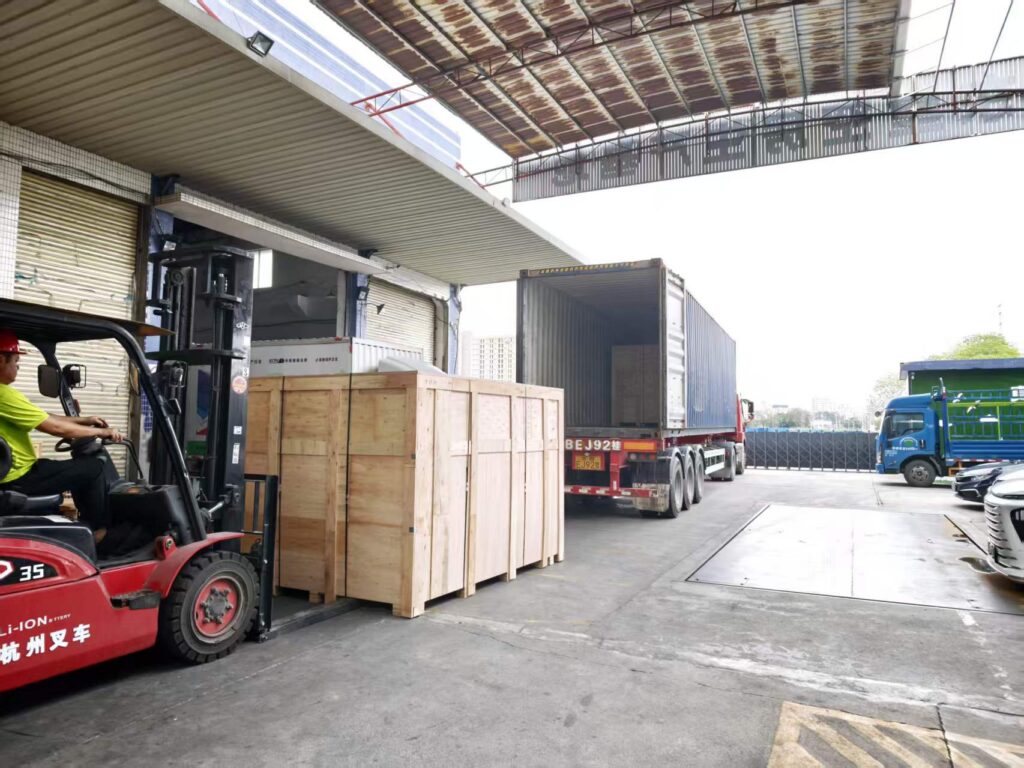
One of the first questions serious buyers ask is not about the dome itself — it is about the container. A 40HQ container costs roughly the same whether it leaves the factory half full or packed to the last cubic metre, so how many dome houses fit in a 40HQ decides your real per-unit landed cost. Get the loading maths right and you can cut your freight cost per dome by nearly half.
This guide covers the published loading density for every model in our range, how flat-pack shipping works, and the method we use to turn a container rate into a freight figure per dome.
40HQ Container Basics
A standard 40-foot high cube (40HQ) container measures approximately 12.03 m long, 2.35 m wide and 2.69 m high inside, giving roughly 76 cubic metres (CBM) of usable volume. The “high cube” height — 2.69 m instead of the standard 2.39 m — matters for dome houses, because a dome kit contains long frame sections and wide panel stacks rather than one tall object.
Two constraints decide how a dome load actually goes together. Volume is the first: at 76 m³, a container is full long before it is heavy. The second is the door opening and the crate footprint — a crate has to pass through the doors and sit flat on the floor, so what fills a container is a combination of crate lengths and heights rather than a single dense block. That is why loading plans are built per model and per order, not guessed.
How Many 4m Dome Houses Fit in a 40HQ
Our most popular export model, the 4 m round dome, packs 30 sets per 40HQ container. Please confirm the final loading quantity with us for your specific order. That means a pilot project of a dozen glamping units ships inside one container, with room to spare — a decisive advantage when you are testing a market before scaling.
By contrast, a 6.2 m dome — our largest round model — fits 16 sets per 40HQ. The pattern is simple: bigger shells consume container volume faster than they add revenue per night. At scale, the difference between the smallest and largest round models can halve your freight cost per unit, which is exactly why we design every model around container packing from day one.
Loading Density by Model Type
Here is the published loading density across the round range:
| Model | Diameter × height | Floor area | Sets per 40HQ |
|---|---|---|---|
| ZH270 | Φ2.7 m × H2.7 m | 5.7 m² | 40 sets |
| ZH350 | Φ3.5 m × H2.8 m | 9.6 m² | 30 sets |
| ZH400 | Φ4.0 m × H3 m | 12.5 m² | 30 sets |
| ZH510 | Φ5.1 m × H3.2 m | 20.4 m² | 24 sets |
| ZH620 | Φ6.2 m × H3.5 m | 30.17 m² | 16 sets |
Read that table as a freight ladder, not a quality ladder. The 2.7 m and 3.5 m models give the highest container density in the range, which suits volume orders where freight per unit must be minimal. The 4 m model is the balance point — 30 sets per container and a floor area that supports a full glamping room. The 5.1 m and 6.2 m models ship fewer sets, but each unit supports larger layouts and higher nightly rates, so the commercial case rests on rate rather than density.
Beyond the round range, our Moon Series elliptical capsules and the spliced Combination Series are built from modules that stay within container-friendly dimensions, which is what allows a resort to ship a mixed order — bedrooms, lounges and larger suites — inside a planned loading sequence rather than as separate shipments.
Not sure which model matches your site? Our dome size guide compares guest experience, site density and freight trade-offs model by model.
Wooden-Pack vs Assembled Shipping
Dome kits ship wooden-packed — frame sections bundled, panels stacked, hardware boxed — and assemble on site in hours per unit with a small crew. This is the only way to reach the densities above, and it is also why installation is simpler than most buyers fear: nothing has to be cut or fabricated on site. Our five-step dome installation guide covers what to expect on delivery day.
Shipping a dome assembled is not practical: a 4 m shell is larger than a container’s internal width, so an assembled unit cannot be lashed into a standard 40HQ at all. Flat-packing is not a compromise — it is the reason a dome can be exported economically in the first place.
Estimating Your Freight Cost
Ocean freight is quoted per container, not per dome, so follow this method:
- Confirm the loading plan from the factory — how many sets per 40HQ for your chosen model.
- Get a current 40HQ rate from a freight forwarder for your destination port (rates swing with season and route).
- Divide the container rate by the number of sets. That is your sea freight per dome.
- Add customs, inland transport and local handling to get the true landed cost.
Two structural points change this calculation. First, if your order is smaller than the published loading density, you are paying for empty space — topping up to a full container with a second model is usually cheaper per unit than shipping a partial load. Second, small orders of one to three units normally move as LCL (less than container load) freight instead of a dedicated container, which is a different rate structure; our shipping cost guide explains where the FCL and LCL break-even sits.
Ask any supplier for their packing list and loading plan before you compare quotes — a factory that cannot tell you how its product loads probably has not designed it for export.
Unloading and Site Storage
The container arrives, and then the real logistics start. Plan for three things before the truck reaches the site. Confirm the crate can be lifted or slid out safely at the destination — a 40HQ load is heavy crate by crate, and a pallet truck or a small forklift makes the difference between a controlled unload and a manual one. Confirm where the crates will be stored: dome kits are weather-resistant in transit but should sit on a dry, level surface rather than directly on wet ground. And confirm the storage area is close enough to the plots that panels can be carried to each foundation without a second vehicle movement.
On a multi-unit site, sequence deliveries to match your installation order. The units you plan to build first should be the last crates loaded — or the first lifted out.
What About Larger Projects?
Projects bigger than a single container mix model types to balance guest experience and freight. A resort that wants premium views, mid-tier rooms and a shared lounge can usually fill containers with a planned combination of models rather than ordering three separate shipments for three separate unit types. We regularly engineer mixed loads and will put together a loading plan for your full order before you commit to anything.
For phased deliveries, the same loading logic applies per batch: define which plots are built in which phase, then load each container to match that phase. It keeps site storage small and lets earlier units start earning before the later ones ship — the approach behind our multi-unit resort case study.
FAQ
How many dome houses fit in a 40HQ container?
A 40HQ fits 30 sets of 4 m round domes, 40 sets of 2.7 m domes, 24 sets of 5.1 m domes and about 16 sets of 6.2 m domes. The exact count depends on the model and any mixed loading, and is confirmed in the factory loading plan — please confirm the final loading quantity with us before you order.
Do dome houses ship assembled or wooden-packed?
Dome kits ship wooden-packed — bundled frame sections and stacked panels — which maximises container density and minimises freight cost. An assembled 4 m shell is wider than the container’s internal width and cannot be shipped in a standard container at all. Assembly on site takes hours per unit with a small crew and simple tools.
Is shipping more expensive for a dome house than a wooden building?
No — the opposite. A wooden-packed dome is engineered to fill standard container volume, which is its biggest cost advantage over pre-fabricated flat buildings whose fixed shape wastes container height.
Can I mix different dome sizes in one container?
Yes. For mixed orders we design a combined loading plan so every cubic metre is used, which is common for resorts that want room variety from day one. Tell us the model mix and we will build the loading sequence around it.
Is freight cheaper if I order in multiples?
Yes. Freight is charged per container, so increasing the order to fill a container lowers the cost per dome. Where an order falls short of a full container, adding a second model is usually cheaper per unit than shipping a partial load.
Ready to start your dome project?
Talk to our engineers or download the full product catalog first.
Related Posts
 13
Oct 2026
13
Oct 2026
PC Dome vs PVC and Canvas Glamping Tents: A Buyer’s Material Guide
PC dome vs PVC and canvas glamping tents: how the shell material decides lifespan, clarity, weather resistance and what you can build.
View More 29
Sep 2026
29
Sep 2026
Dome House for Backyard Glamping: How to Plan Your First Unit
Dome house for backyard glamping, planned properly: right size, level base, power, heating and what one unit needs before delivery day.
View More