
Delivering a 30-Dome Beachfront Resort: A Complete Camp Solution
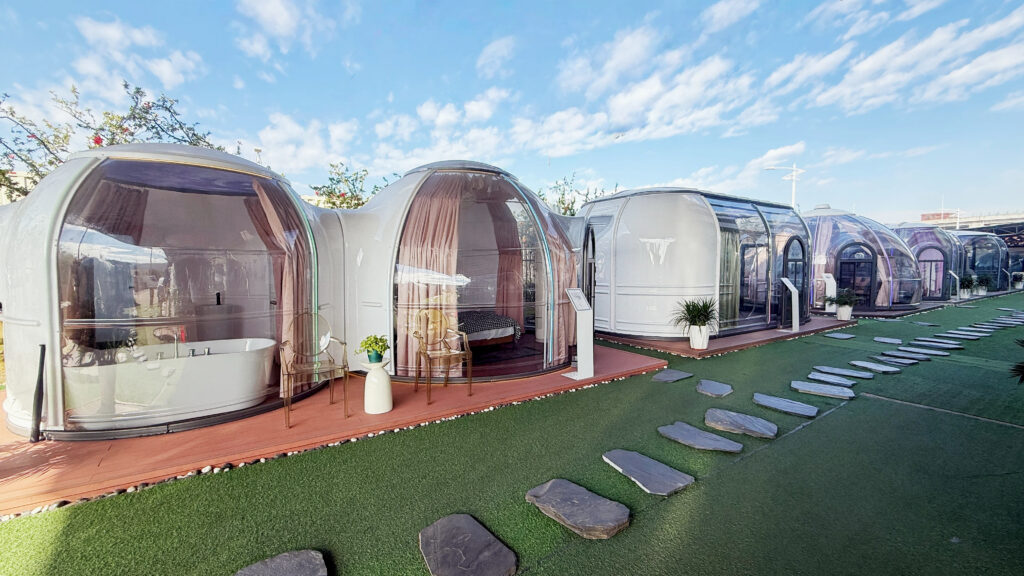
The client came to us with a beachfront plot and a hard deadline. Rather than buying domes in pieces — then hoping the site plan, utilities and interiors would somehow come together — they chose a complete camp solution: one contract covering site survey, layout, units, utilities and interiors. This is how that single-contract approach opened a coastal resort in phases, and what the process looks like from the inside.
The Brief: Beachfront Plot, Hard Deadline
The operator had already secured the land and the seasonal window. What they lacked was time: the booking season was fixed, and every week of slippage meant lost revenue. A fragmented approach — sourcing domes from one supplier, decking from another, HVAC from a third — would have pushed opening day past the season entirely.
That is why they asked for a single-contract camp solution. One vendor accountable for the plan, the product and the delivery schedule. It is a model we recommend for any project where opening date drives revenue, because it converts supply-chain risk into a single point of responsibility. When something runs late on a phased build, there is one conversation instead of three.
Site Planning: 3D Modelling Before a Single Panel Is Ordered
Our engineers modelled the site in 3D before production began. Thirty units had to be placed across a coastal plot where three forces compete: ocean views, wind exposure and guest privacy. A dome with the perfect view but no wind shelter becomes a maintenance problem; a sheltered dome with no view becomes a booking problem.
The 3D layout resolved those conflicts on screen first. Each unit’s orientation, spacing and deck position was fixed before anything shipped, which is also why assembly on site went as fast as it did — the crew was following a proven plan, not improvising. A layout that exists only as a sketch is not a layout; it is a set of decisions left for the installation crew to make in the rain.
What a Complete Camp Solution Actually Includes
The scope is worth spelling out, because “turnkey” is used loosely in this industry. On a project like this one, a single contract covered:
- Site planning and 3D layout — unit placement, orientation, deck positions and phasing sequence.
- The units themselves — shells, frames, doors, windows, exhausts and hardware, shipped flat-packed.
- Utilities planning — power, water and drainage routed per plot before the decks were built.
- Interior specification — the option list built into the order rather than added later: composite flooring kits, blackout curtains, LED light strips, air-conditioner base and mount, smart locks, skylight exhaust fans and outward-opening casement windows.
- Installation support — remote guidance for the local crew through the first builds.
Ordering interior items at production time is a large part of why the later phases stayed on schedule: nothing had to be sourced locally after the units landed.
Mixed Model Strategy: Three Models, Thirty Units
The resort does not run thirty identical rooms. The final plan mixed three model types from our Star Series, Moon Series and Combination Series:
- Round domes for the premium ocean-view units guests book first — the 4 m shell, at 12.5 m² and around 220 kg, being the workhorse of the range.
- Elliptical capsules where the plot shape favoured a long, low footprint and better wind behaviour.
- Spliced combination units where the resort wanted a larger suite or a shared lounge — the two-module layouts run from 15.3 m² to 35.87 m².
Room variety matters more than most first-time developers expect: it lets the resort price by experience tier, spread occupancy across unit types, and photograph a richer story for marketing. It also de-risks the season — if the top tier slows, the mid tier still fills.
Phased Shipping: Thirty Units in Batches
Phased shipping was the key to the schedule. The thirty units were produced and shipped in sequenced batches — the first group arrived in time for opening day, with the remainder following at two-week intervals until the resort was fully operational. This works because every dome flat-packs into standard containers: a 40HQ carries 30 sets of the 4 m model, so a batch maps cleanly onto whole containers — see our container loading guide for the densities.
Phasing is also gentler on cash flow and site logistics: one delivery to manage per phase, one crew to schedule, less storage on a coastal plot, and revenue from earlier phases funding the later ones. The plan has to be set before the first container ships, though — the model mix in each batch determines which plots get built when.
Assembly: Local Crew, Remote Guidance
Local crews handled the assembly with our remote guidance. Because a dome is a bolted structure of numbered frame segments and pre-cut panels, a small crew with basic tools can stand one up in hours — 3–5 hours for a 4 m shell with three people, and 5–7 hours for a 6.2 m shell with four to five. Our 5-step installation guide shows exactly what delivery day looks like. No specialist welders, no crane dependency, no factory technicians travelling to site.
The remote guidance model is one of the biggest cost advantages of buying factory-direct from a manufacturer that has shipped internationally before: your local labour stays local, and the engineering knowledge arrives by video call. On a thirty-unit site, that also means the crew gets faster with every unit — the tenth dome is not built at first-dome speed.
Two Cyclone-Adjacent Seasons Later
The maintenance question every buyer asks is durability. Two cyclone-adjacent seasons after opening, the powder-coated frames show no structural issues — the failure scenario the client was most worried about never materialised.
That outcome is not luck; it is what the specification is for. Our round shells are published at 120 km/h wind load and 45 kg/m² snow load, carried on a 6063-T5 aluminium frame with powder-coated corrosion protection and UV-protected polycarbonate panels, and specified for a 10-year frame life with a 20-year panel life and a no-yellowing claim. On a coastal site those are the numbers to compare against your own local wind requirement, which is why we ask every buyer for their site’s figure before quoting.
The maintenance regime behind that record is deliberately small: wash the panels, inspect the seals, check the frame. There is no annual re-proofing cycle as there would be with fabric, and no canvas replacement to budget for — the recurring cost line simply is not there.
FAQ
What is a complete camp solution for a dome resort?
A single-contract approach where one supplier handles site survey, 3D layout, units, utilities planning, interior specification and installation support — instead of the buyer coordinating multiple vendors. It converts supply-chain risk into one point of responsibility and protects the opening date.
How long does it take to install a 30-dome resort?
With phased shipping and a local crew, the first batch of units can be operational for opening day, with the remaining batches following at roughly two-week intervals. Each shell assembles in hours with numbered frame segments and pre-cut panels — 3–5 hours for a 4 m shell with three people.
Can dome houses survive coastal weather?
Yes, when specified for it. Our round models are published at 120 km/h wind load and 45 kg/m² snow load, with a 6063-T5 powder-coated aluminium frame and UV-protected polycarbonate panels, and the powder coating is the corrosion protection that matters on a coastal site.
Why mix different dome models in one resort?
Mixed models create room variety — premium round domes for ocean views, capsules for sheltered or narrow plots, spliced units for larger suites — which supports tiered pricing, spreads occupancy across price points and enriches the resort’s marketing story.
Do I need to be on site during installation?
No. Local crews carry out the build with our remote guidance, and every project includes support through the first installation. Because the parts are numbered and pre-cut, the crew works from a drawing set rather than judgement — which is what allows a first-time team to complete a shell in a single day.
Ready to start your dome project?
Talk to our engineers or download the full product catalog first.
Related Posts
 13
Oct 2026
13
Oct 2026
PC Dome vs PVC and Canvas Glamping Tents: A Buyer’s Material Guide
PC dome vs PVC and canvas glamping tents: how the shell material decides lifespan, clarity, weather resistance and what you can build.
View More 29
Sep 2026
29
Sep 2026
Dome House for Backyard Glamping: How to Plan Your First Unit
Dome house for backyard glamping, planned properly: right size, level base, power, heating and what one unit needs before delivery day.
View More