
Dome House Shipping Cost from China: FCL vs LCL Freight Explained
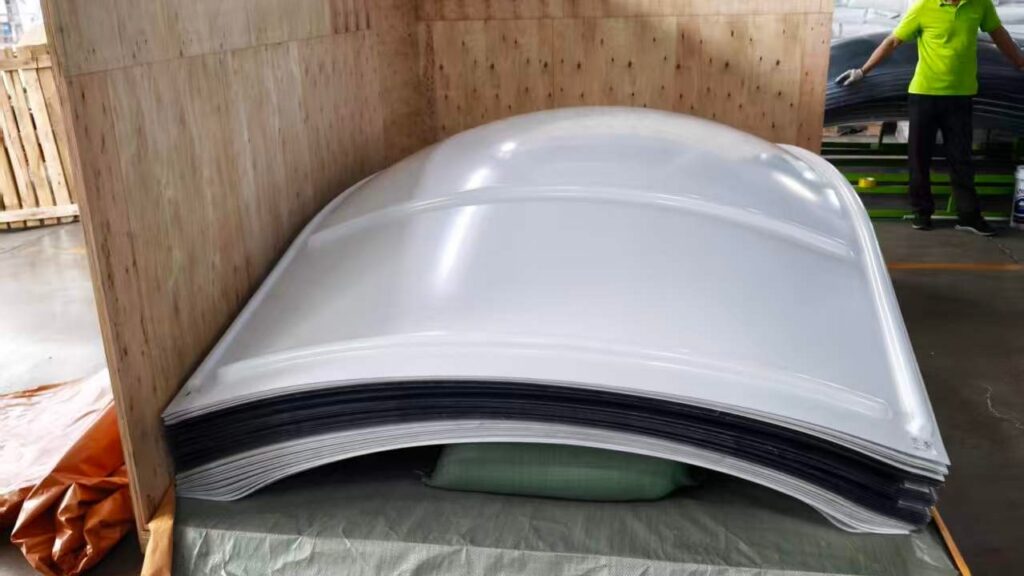
Freight surprises most first-time dome buyers. The dome gets quoted to the dollar, but until you know how the kit packs and how that space is charged, your landed cost is guesswork. This guide covers the packing data behind dome house shipping cost, the FCL versus LCL decision, and what a quotation must include before two suppliers can be compared.
What Actually Drives Dome House Freight Cost
Ocean freight is not priced per dome. It is priced by the space your goods occupy and, on some routes, by weight. Three numbers decide the invoice.
Cubic metres (CBM) — the volume your packed crates occupy, and the number that matters most, because container space is sold by volume. Gross weight — the crate including its wooden case, not the dome’s net weight. Chargeable weight — the LCL conversion, commonly 1,000 kg per cubic metre, where the higher of weight and volume applies.
For dome kits the answer is almost always volume. A 4 m round dome packs into 7.74 m³ with a gross weight of 460 kg — a volumetric equivalent of 7,740 kg. The freight is calculated on the space, not the scale. Dome houses cube out long before they weigh out, and that single fact shapes everything else about shipping them economically.
Real Packing Data: Crate Volume and Weight by Model
These are the standard export crates for the round Star Dome range, as packed for shipment.
| Model | Floor area | Crate · 1 set | Gross weight · 1 set | Crate · 3 sets | Gross weight · 3 sets |
|---|---|---|---|---|---|
| ZH270 · 2.7 m | 5.7 m² | 5.5 m³ (2.5 × 2.2 × 1.0 m) | 320 kg | 7.15 m³ | 630 kg |
| ZH350 · 3.5 m | 9.6 m² | 6.47 m³ (2.8 × 2.2 × 1.05 m) | 380 kg | 8.46 m³ | 740 kg |
| ZH400 · 4.0 m | 12.5 m² | 7.74 m³ (3.2 × 2.2 × 1.1 m) | 460 kg | 10.37 m³ | 950 kg |
| ZH510 · 5.1 m | 20.4 m² | 9.9 m³ (3.75 × 2.2 × 1.2 m) | 560 kg | 13.2 m³ | 1,235 kg |
| ZH620 · 6.2 m | 30.17 m² | 12.58 m³ (4.4 × 2.2 × 1.3 m) | 700 kg | 16.46 m³ | 1,520 kg |
Crate volume grows far more slowly than floor area: the 6.2 m dome has 2.4 times the floor area of the 4 m model but only about 60% more crate volume. The three-set crate is also the more efficient packing — 10.37 m³ for three 4 m domes instead of 23.2 m³ in three separate crates.
Above both sits a third option. Bulk container orders use a combined loading plan rather than one crate per set, so effective volume per unit keeps falling as order size grows. That plan is model- and quantity-specific, so always ask the factory for the loading plan for your exact order — our 40HQ loading guide shows how sets per container are counted.
FCL or LCL: Choosing the Cheaper Option
LCL (less than container load) shares a container with other cargo, and you pay per cubic metre plus origin and destination charges — the practical choice for one unit, a pilot dome or a two-to-three set order. FCL (full container load) books the whole box, roughly 33 m³ for a 20 ft and 76 m³ for a 40HQ, and you pay for the container however full it is.
The two pricing models cross at some volume, and that crossing point is your decision line. Take your total crate volume from the table above, ask your forwarder for an LCL rate per CBM and an FCL rate for the same lane and date, and ask at what volume FCL becomes cheaper — every forwarder knows that figure for their own route.
Below the break-even, LCL wins. Above it, FCL does, and the marginal cost of adding another dome to a container you have already paid for is close to zero. That is why experienced buyers order in batches rather than one unit at a time; the MOQ, lead time and payment guide explains how standard models can be ordered singly, but shipping economics reward volume. One timing warning: LCL consolidation adds transit time while your crate waits for other cargo, and that wait belongs in your opening-date plan.
What a Freight Quotation Should Include
The most expensive mistake in dome shipping is comparing quotations that are not quoting the same thing, so start with the Incoterm.
- FOB — the supplier delivers to the port of loading; everything after that is yours.
- CIF — the supplier covers the ocean leg to your destination port. Local charges, customs and inland delivery are still yours.
- DDP — delivery to your site with duty paid. The simplest basis to budget, and the one to ask for if you have no import experience.
Then confirm the destination side is priced, because that is where a cheap-looking quote turns expensive. A complete landed cost covers ocean freight, origin and destination terminal handling, documentation, customs brokerage, duty and VAT, insurance, and inland trucking. If a line is missing, add it before comparing totals — our price breakdown guide lists what belongs in a dome quotation.
Where Buyers Lose Money on Dome Shipping
Forgetting the unloading equipment. A crate for a 6.2 m dome is 4.4 m long and weighs 700 kg, and someone has to lift it off the truck. Confirm whether the delivery point has a forklift before shipment.
Assuming the dome ships assembled. It cannot. Every dome ships flat-packed — dismantled frame, stacked panels, wooden case — which is what makes these densities possible at all.
Not budgeting site work in parallel. Ground work is normally the part that slips, not the dome. The foundation options guide covers the three common base types and how long each takes.
How to Calculate Landed Cost per Dome
Work in this order and the final invoice will not surprise you:
- Confirm crate volume and gross weight for your model in the packing table.
- Total the volume for the number of sets shipping.
- Get current LCL and FCL rates for your port and choose the cheaper basis.
- Add destination charges, customs brokerage, duty and inland delivery.
- Divide by the number of domes in the shipment.
That last figure is the only one worth comparing between suppliers. Rates move with the season, so quote close to your order date. If you are still choosing a size, weigh crate volume against floor area in the table — the 4 m round dome and the 6.2 m model sit at opposite ends of that trade-off, with the rest of the Star Series between them.
FAQ
How much does it cost to ship a dome house from China?
No single figure applies, because ocean freight moves with the route, season and fuel prices. What you control is the volume you pay for. Take the crate volume from the packing table, get a current rate for your destination port, and divide by the sets in the shipment. A 4 m dome occupies 7.74 m³ in a single-set crate and 3.46 m³ per set in a three-set crate, so order size moves the per-unit figure more than anything else.
Is it cheaper to ship a dome house by LCL or FCL?
LCL is cheaper for one to three sets, because you pay only for the space you use. FCL wins once your volume passes the crossing point for your lane, because you pay for the container instead of the cubic metres. Ask your forwarder for both rates at your exact volume and let the totals decide.
Do dome houses ship assembled or flat-packed?
Flat-packed. The aluminium frame is dismantled and the polycarbonate panels are stacked in a wooden export crate, then assembled on site in hours with basic hand tools. Shipping an assembled dome would waste most of the container’s volume. The 5-step installation guide covers what assembly involves.
How heavy is a dome house shipping crate?
From 320 kg for the 2.7 m model to 700 kg for the 6.2 m model in a single-set crate, rising to 630 kg and 1,520 kg for the equivalent three-set crates. Even the heaviest sits far inside a container’s payload limit, which is why dome freight is calculated on volume rather than weight.
What does DDP mean for a dome house order?
DDP (delivered duty paid) means delivery to your site with import duty settled, so your landed cost is known before you order — the simplest basis for a first order. FOB and CIF quote only part of the journey.
Send us your destination port, the model and the quantity, and we will quote FOB, CIF or DDP with the loading plan attached. Request a quote and we will confirm crate volume and weight for your order.
Ready to start your dome project?
Talk to our engineers or download the full product catalog first.
Related Posts
 13
Oct 2026
13
Oct 2026
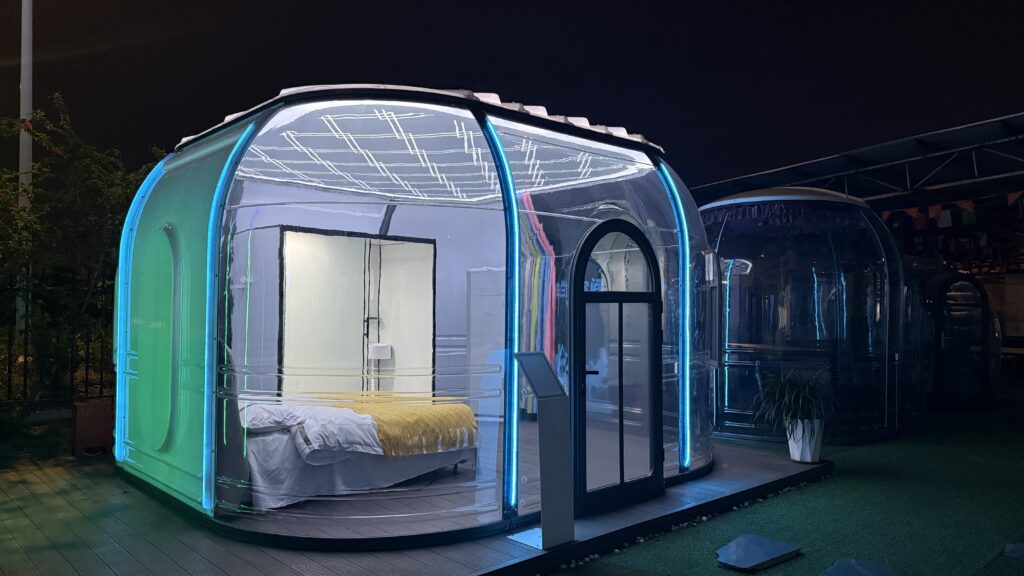
PC Dome vs PVC and Canvas Glamping Tents: A Buyer’s Material Guide
PC dome vs PVC and canvas glamping tents: how the shell material decides lifespan, clarity, weather resistance and what you can build.
View More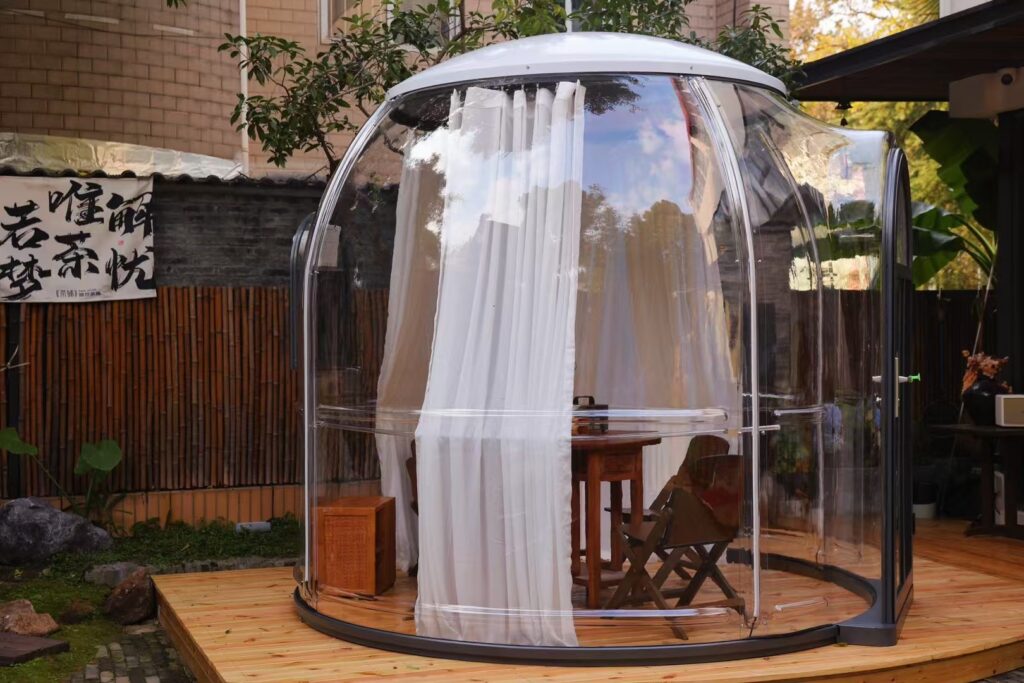 29
Sep 2026
29
Sep 2026
Dome House for Backyard Glamping: How to Plan Your First Unit
Dome house for backyard glamping, planned properly: right size, level base, power, heating and what one unit needs before delivery day.
View More