
Dome House for Backyard Glamping: How to Plan Your First Unit
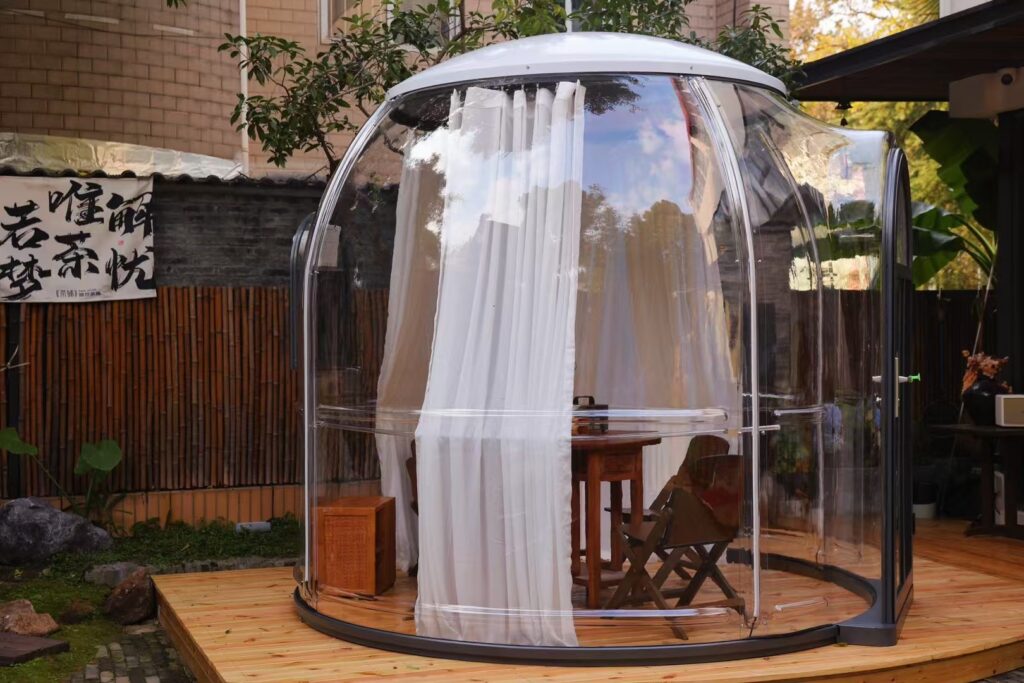
A backyard dome is the smallest honest version of glamping: one transparent shell on one level base, close enough to the house for power and water, and far enough away to feel like somewhere else. It is also the most economical way to learn how a dome behaves on your own ground before committing a site to thirty of them.
This guide covers the four decisions that matter — size, base, services and crew — for the homeowner who wants a garden room that is not a shed, and for the host testing one rental unit.
What a Backyard Dome Is — and What It Is Not
A dome is a rigid shell: a 6063-T5 aluminium frame with a powder-coated finish, skinned in UV-protected polycarbonate — 3 mm on the 2.7 m, 3.5 m, 4 m and 5.1 m models, and 3.5 mm on the 6.2 m. On a domestic site that matters for one reason: there is no fabric, so nothing sags, nothing needs re-proofing every spring, and nothing comes down at the end of a season.
It is not a building, though. The published structural figure for the round models is a combined wind and snow load rating of 120 km/h and 45 kg/m² — a specification, not a building permit. Whether your municipality treats a dome as temporary or permanent is a local question worth answering before you order.
Nor does it condition itself: heating, ventilation and shading are designed on top of the shell, which is the part buyers underestimate most. Our winter-proofing and ventilation guides cover both climate extremes.
Choose the Size First: 2.7 m, 3.5 m or 4 m
| Model | Diameter × height | Floor area | Capacity | Net weight | Assembly |
|---|---|---|---|---|---|
| ZH270 | Φ2.7 m × H2.7 m | 5.7 m² | 2–4 persons | ≈135 kg | 2 workers × 2 hours |
| ZH350 | Φ3.5 m × H2.8 m | 9.6 m² | 6–8 persons | ≈160 kg | 2–3 workers × 3 hours |
| ZH400 | Φ4.0 m × H3 m | 12.5 m² | 8–10 persons | ≈220 kg | 3 workers × 3–5 hours |
The diameter governs everything, because the usable floor is a circle. At 2.7 m the floor area is 5.7 m² — a sleeping pod, where a bed and a small table fit and little else. At 3.5 m it opens to 9.6 m² and starts to behave like a room; at 4 m it reaches 12.5 m² and two people can share it without rearranging the furniture.
Our published capacity figures follow the same curve: 2–4 persons at 2.7 m, 6–8 at 3.5 m and 8–10 at 4 m. Read those as gathering capacity rather than beds — floor area, not the headline number, tells you what will fit. If you are weighing two sizes, the size selection guide works through the same trade-off, and the Star Series lists the full range.
Site Prep: The Base Comes First
Every dome sits on a level, load-bearing base, and frame tolerances are tight — slope ignored at the base becomes hours of shimming later. Three options cover domestic sites: a wooden deck (fastest, and it gives the unit a finished floor), a concrete pad (the most permanent, and the right answer on soft ground or where the dome must carry snow), and ground screws (the quickest, they cope with slopes, and they leave no permanent footprint). Our foundation options guide compares them properly.
Two details are backyard-specific. Drainage comes first: water has to leave the base rather than pool under it, so plan the fall of the ground and any gutter before the deck goes down. Access comes second, because the dome arrives as a single flat-packed crate:
| Model | Crate dimensions | Crate volume | Crate weight |
|---|---|---|---|
| ZH270 | 2.5 × 2.2 × 1.0 m | 5.5 m³ | 320 kg |
| ZH350 | 2.8 × 2.2 × 1.05 m | 6.47 m³ | 380 kg |
| ZH400 | 3.2 × 2.2 × 1.1 m | 7.74 m³ | 460 kg |
Measure the side return and the gate before you choose a model — a car passes through a narrow gap, a 320 kg crate on a pallet does not. Single units normally move as LCL freight rather than inside a full container, and the shipping cost guide explains the FCL versus LCL break-even.
Services: Power and Climate
Settle the services before the deck is built. One power supply is enough — lighting, a socket for charging and an air-conditioner — and the kit can be specified with a flooring kit, LED strips at the top and bottom of the shell and a skylight exhaust fan. Each of the 2.7 m, 3.5 m and 4 m models ships with one exhaust, and outward-opening casement windows can be added.
In hot climates shading comes first and mechanical cooling second; in cold ones the limiting factor is never the shell but insulation, condensation control and a sealed entry. An air-conditioner base and mount is on the option list. Also on the list, because they are finishes rather than services: blackout curtains in 20 colours, motorised overhead curtains, an exterior awning, a smart lock upgrade, a custom frame colour, and PC panels thickened to 3.5–4.5 mm.
Delivery Day: Crew, Tools and Time
Shell assembly is a same-day job with no lifting equipment. The frame arrives in numbered sections and the panels arrive pre-cut and pre-drilled, clipping into the aluminium profiles — there is no cutting and no gluing on site.
What rewards care is the torque specification on every bolted connection — under-tightened joints loosen in wind, over-tightened ones stress the aluminium — and the sealing tape along each panel joint, which decides the dome’s weather performance for years. The five-step installation guide walks through each stage with its times, tools and crew size.
Those times assume a prepared base and exclude the foundation, services and interior fit-out, so a first installation usually fills a day. Every project includes remote installation support, so your first build happens with our team on the call.
One Unit for Yourself, or One Unit as a Rental?
A private garden unit is a lifestyle decision: choose the size that fits the space and stop there. A rental unit is a business decision, which makes the shell only the first line of the budget — the base, the services, the interior and site access all count, and after that occupancy decides everything.
We do not publish prices, because a quotation depends on size, panel thickness, the options you select and the destination. What we can do is show the arithmetic: the break-even model sets out the relationship between investment, occupancy and nightly rate, and leaves you a blank table for your own numbers.
The advice is the same either way — pilot with one unit before committing a plot to a village.
What to Check Before You Order
Panel and coating. Ask for the sheet thickness and the UV-coating guarantee in writing. The round models carry a 20-year PC panel specification with a no-yellowing claim alongside a 10-year frame warranty, and the reasoning behind both is in the lifespan guide.
Frame. 6063-T5 aluminium with powder coating is the specification to compare against; on a coastal site, the corrosion protection is the line that matters.
Ratings. The 120 km/h wind and 45 kg/m² snow figures are published for the round models. Our oval, capsule and square units do not currently carry a published rating line, so on an exposed site ask about the specific model.
Kit completeness. Numbered parts, pre-cut panels and remote support for the first build. The quality checklist lists what to inspect on arrival, and volume and weight per set are published on each product page. For a quotation built on your own dimensions, send us the plan.
FAQ
Can I put a glamping dome in my backyard?
Yes, provided you have a level, load-bearing base and your local rules allow it. The round range starts at Φ2.7 m with a 5.7 m² floor, which suits a small garden.
How much space does a backyard glamping dome need?
At minimum, the footprint of the base plus working space around the shell. The dome is Φ2.7 m, Φ3.5 m or Φ4.0 m across, and the deck should extend beyond that diameter so there is room to work around the frame during assembly and maintenance.
Do I need planning permission for a backyard dome?
It depends on whether your municipality treats a dome as temporary or permanent, and requirements vary by region. Confirming compliance in advance is far cheaper than retrofitting it afterwards.
How many people does it take to install a backyard dome?
Two people handle the 2.7 m and 3.5 m shells, which take about two and three hours respectively. A 4 m shell is more comfortable with three people and takes three to five hours. No crane, welding or specialist contractor is required.
Can a backyard dome be used in winter?
Yes. The shell is rigid and rated to 45 kg/m² snow load on the round models, so the structure is rarely the limiting factor — heating, insulation, condensation control and a sealed entry are what make a winter season comfortable.
Ready to start your dome project?
Talk to our engineers or download the full product catalog first.
Related Posts
 13
Oct 2026
13
Oct 2026
PC Dome vs PVC and Canvas Glamping Tents: A Buyer’s Material Guide
PC dome vs PVC and canvas glamping tents: how the shell material decides lifespan, clarity, weather resistance and what you can build.
View More 22
Sep 2026
22
Sep 2026
Dome House Cost per Square Meter: Why Size Changes the Ratio
Why dome house cost per square meter falls as diameter grows - what belongs in the ratio, what to exclude, and how to compare supplier quotes fairly.
View More