
Winter-Proofing Your Dome House: Heating, Insulation and Snow Load
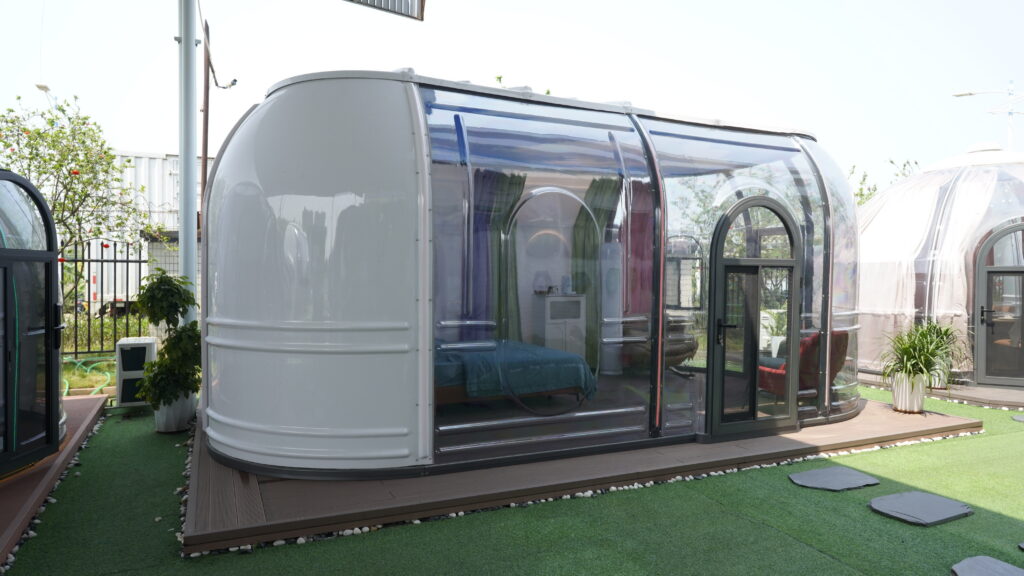
A transparent dome in snow is one of the most bookable rooms in hospitality — guests pay a premium to watch snowfall through a full panoramic shell. But a winter-proof dome is a planning problem, not a product problem. Snow load, heating, airflow and insulation must be designed together before the first booking. Here is the checklist we give every buyer operating in cold climates.
If you only take one thing from this guide, take this: the shell is rarely the limiting factor in a winter dome. What decides whether a unit is comfortable in January is the specification choices made before production — ventilation, covering, heating and the panel itself.
Snow Load: Know Your Site’s Rating
Snow load is measured in kilograms per square metre (kg/m²) — the weight of snow a roof must carry. Our published rating for the round models is 45 kg/m² of snow load and 120 km/h of wind load, alongside a 6063-T5 aluminium frame and 3 mm UV-protected polycarbonate panels (3.5 mm on the 6.2 m model).
Two points matter when you compare that number with your site. First, the rating is published for the round models specifically — our oval, capsule and square units do not currently carry a published rating line, so if your site is exposed, ask us about the exact model rather than assuming the round figure applies. Second, a snow-load requirement varies dramatically by region, so check your local building authority’s figure before ordering, and tell us the number rather than the region. If your site’s requirement is higher than our published rating, raise it at quotation stage: the specification decision has to be made at the factory, not reinforced on site.
One advantage is built into the shape. A dome sheds snow from a curved surface with no flat valley to collect drift, and the round section has no large unsupported span. That geometry is why a dome handles winter better than its material weight suggests — but it does not replace knowing your site’s number.
Heating: Size the HVAC Correctly
Heating works best with a correctly sized unit and the mounting base we supply, which keeps the air-conditioner on the frame rather than on the floor. The rule of thumb: a dome’s volume, not its floor area, drives the heating requirement, so an oversized unit short-cycles and an undersized unit never catches up.
Heat pumps are the most common choice for year-round glamping — efficient in mild cold, reversible for summer cooling. Electric radiant or oil-filled heaters suit small units and seasonal use. Whatever you choose, plan the mounting point and the cable route at the layout stage, because retrofitting heating into a finished interior is far more expensive than designing it in.
There is a second reason to plan the mounting point early. In a transparent shell the interior is visible from outside, so how the unit is mounted affects the room’s look as much as its performance — the air-conditioner base and mount exists precisely so the hardware reads as part of the design rather than an addition.
Passive Solar: The Transparent Shell Advantage
Unlike canvas tents, a transparent PC dome acts as a passive solar collector. On sunny winter days the shell lets sunlight in and traps it — interior temperatures can climb well above ambient, reducing heating demand during daylight hours. The same physics works against you at night, which is why insulation and heat retention matter.
Pair the shell with thermal curtains or interior panels on the shaded side and a correctly sized heating system, and the dome holds heat far better than fabric alternatives. The transparent wall that sells the room is also the wall that heats it — and thick blackout curtains, available in 20 colours, are the cheapest thermal upgrade on the whole option list. Motorised overhead curtains are also available if you want the covering to operate without guests climbing to reach high windows.
Insulation Options We Can Supply
Insulation on a transparent dome is mostly about covering, not cladding. The specification levers that matter in a cold climate are:
- Thicker PC panels. Panels can be specified between 3.5 and 4.5 mm instead of the standard 3 mm (4–4.5 mm on the 6.2 m model), which adds a little thermal resistance and stiffness.
- Thermal coverings. Thick blackout curtains in 20 colours, plus motorised overhead curtains for the upper shell.
- Air-conditioner base and mount. Positions the heating or cooling unit on the frame, with a defined cable route.
- Composite flooring kit. Puts an insulated floor under the guests instead of leaving the deck exposed.
- Skylight exhaust fan. The controllable air path that makes the sealed shell usable.
Choosing these at order time is straightforward; adding them after delivery means new crates, new freight and a second installation visit.
Condensation Control: Ventilation and Airflow
Condensation is the real enemy in winter. Warm, moist air from guests meets a cold shell and condenses into water on the panels — the fastest way to ruin an interior. The solution is deliberate ventilation: an extraction path for moist air plus controlled fresh-air intake.
The shell is already provided with an exhaust path by model — one exhaust on the 2.7 m, 3.5 m and 4 m models, two on the 5.1 m and three on the 6.2 m — and outward-opening casement windows can be added for manual control. For cold-climate sites we recommend adding the skylight exhaust fan, which gives the operator a controllable airflow path rather than relying on guests to open a window in freezing weather. The aim is not to keep the dome cold; it is to keep the interior above dew point while the heat is running.
The Winter Operations Checklist
- Confirm your site’s snow-load requirement and check it against our published rating for the model you are buying.
- Size the heating to the dome’s volume, not its floor area, and mount it on the base we supply.
- Use the passive-solar effect — let sunlight in during the day, close thermal coverings at night.
- Specify the ventilation path before the first cold snap: exhaust plus skylight fan, with casement windows where guests need manual control.
- Add the flooring kit so the guest is not standing on an exposed deck.
- Schedule a pre-season inspection of seals, vents and heating before bookings begin.
Winter-proofing starts at specification, not at the site. Our engineering team includes snow-load and heating advice in every quotation — talk to us about your site and we will help you size it correctly. For a reference installation, see our Canada Aurora glamping dome project. You can also compare how the polycarbonate shell behaves against other glazing options in our PC vs glass comparison, or work through the build sequence in the installation guide.
FAQ
Can dome houses handle snow?
Yes — our round models are published with a 45 kg/m² snow load rating and a 120 km/h wind load rating on a 6063-T5 aluminium frame. Compare that figure with your local building authority’s requirement before ordering, and raise any higher requirement with us at quotation stage, because the specification is set at the factory rather than on site.
How do you heat a dome house in winter?
With a correctly sized unit — heat pumps are the most common choice — mounted on the air-conditioner base we supply. Size it to the dome’s volume rather than its floor area, and plan the mounting point and cable route at the layout stage. Domes also act as passive solar collectors on sunny days, reducing daytime heating demand.
Do transparent domes get condensation in winter?
They can, if ventilation is not planned. Every model ships with an exhaust path — one on the 2.7 m, 3.5 m and 4 m models, up to three on the 6.2 m — and we recommend adding the skylight exhaust fan for cold-climate sites so the operator has controllable airflow instead of relying on guests to open a window.
Is a dome warmer than a glamping tent in winter?
Yes. A rigid PC shell with thermal coverings retains heat far better than canvas, and the transparent panels collect passive solar heat during the day — a combination fabric tents cannot match. The panel itself is not insulated, so the heat retention comes from the covering strategy and a correctly sized heating unit.
Does a dome need a different foundation for snow?
A dome needs a level, load-bearing base in any climate. In heavy-snow regions a concrete pad is the most common choice because it also resists frost movement, while decks and ground screws suit lighter-load sites. Our foundation options guide compares all three.
Ready to start your dome project?
Talk to our engineers or download the full product catalog first.
Related Posts
 13
Oct 2026
13
Oct 2026
PC Dome vs PVC and Canvas Glamping Tents: A Buyer’s Material Guide
PC dome vs PVC and canvas glamping tents: how the shell material decides lifespan, clarity, weather resistance and what you can build.
View More 29
Sep 2026
29
Sep 2026
Dome House for Backyard Glamping: How to Plan Your First Unit
Dome house for backyard glamping, planned properly: right size, level base, power, heating and what one unit needs before delivery day.
View More