
Glamping Dome Business: How Many Nights to Break Even?
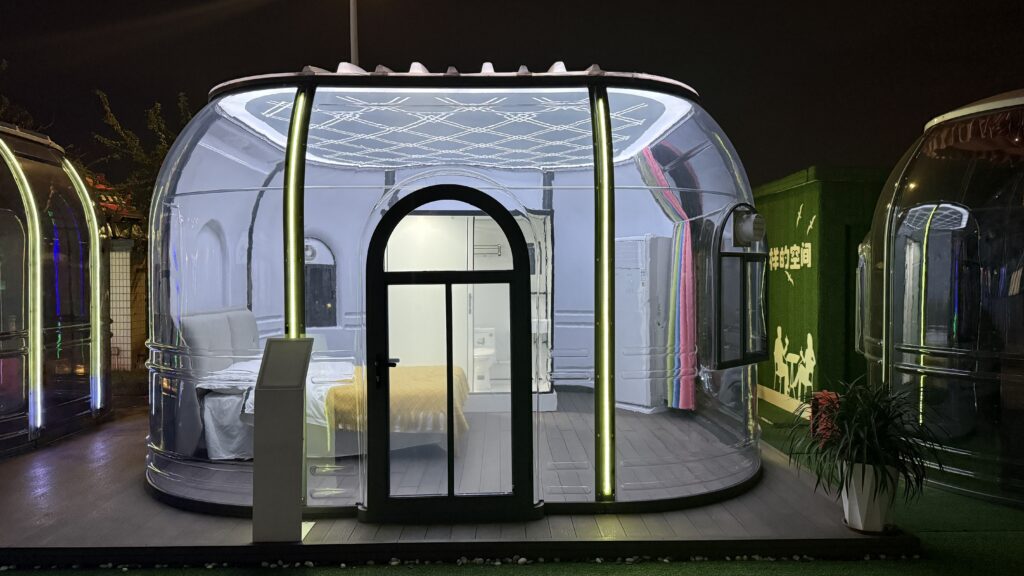
Every dome buyer eventually asks the same question: if I open a glamping site, how long until I get my money back? The honest answer is that it depends on two numbers you control — what you invest and what you charge per night — and one number you do not: occupancy.
This article breaks the calculation down into its parts, shows you how to build a break-even model with your own figures, and points out the operating decisions that move the result more than any single purchase decision.
What “Break Even” Really Means for a Glamping Dome
Breaking even means your cumulative net profit has covered your total upfront investment. Every booked night after that point is profit. The core formula is simple:
Break-even nights = Total investment ÷ Net profit per occupied night
Two common mistakes confuse this number. The first is comparing investment against gross rate instead of net profit — forgetting cleaning, platform fees, utilities and linen can inflate the payback picture by 30–40%. The second is ignoring seasonality: a resort that only books 90 nights a year needs a very different model from one that runs all year.
What Your Investment Actually Includes
A dome purchase is only part of the opening cost. Build your list before you sign anything:
1. The dome kit itself. Frame, panels, doors and windows. Standard models such as the 4m round dome or the larger 6.2m unit are the usual starting points, and the model you choose drives everything else in this list.
2. Foundation and site works. Deck, concrete pad or ground screws. A level base is a one-off cost that protects the structure for its whole life — our installation guide explains what each option requires.
3. Furnishing and utilities. Bedding, heating or cooling, lighting, and a bathroom solution if you are not connecting to existing facilities. These costs vary more by your standard than by dome size.
4. Logistics. Dome kits are designed to pack flat for shipping — a 40HQ container holds 30 sets of the 4m model or 16 sets of the 6.2m model, which is why shipping economics improve sharply when you buy in multiples. Please confirm the final loading quantity with us for your specific order.
Your supplier’s quotation sheet is the ground truth for item 1. Use it as the anchor and build the rest of the budget around your site’s specific requirements.
Pricing Your Dome Night: Start from the Experience, Not the Structure
Guests do not pay for a frame and panels — they pay for a private, panoramic, all-weather room. Price against comparable experiences in your area (boutique cabins, safari tents, resort rooms) rather than against what the structure cost you.
Transparent domes justify a position at the premium end of local glamping rates for three reasons: the uninterrupted view (a 360-degree selling point no fabric tent matches), year-round comfort that keeps the unit bookable in shoulder seasons, and a distinctive look that photographs well and markets itself.
Practical pricing tactics: set a base rate for weeknights, a premium for weekends and holidays, and a deeper low-season rate that keeps the dome occupied rather than empty. Dynamic pricing tools handle this automatically once you have your floor price defined.
The Break-Even Model: A Table You Can Fill In
Build the model in four steps with your own numbers:
Step 1 — Total investment. Sum of dome kit, foundation, furnishing and logistics.
Step 2 — Net profit per night. Your nightly rate minus cleaning, platform commission, utilities and linen. This is the number that matters — if your rate is 100 units and costs eat 40, your net is 60.
Step 3 — Occupancy scenarios. Model three cases: a cautious first year (low occupancy), a steady-state year (medium), and a peak-season performance (high).
Step 4 — The math. Break-even nights = total investment ÷ net profit per night. Then divide by your expected occupied nights per year to get the payback period in months.
| Scenario | Occupied nights / year | What you calculate |
|---|---|---|
| Conservative first year | Your estimate | Break-even nights ÷ low figure → payback in months |
| Steady state | Your estimate | Break-even nights ÷ mid figure → payback in months |
| Peak performance | Your estimate | Break-even nights ÷ high figure → payback in months |
Work through the same table with your real quotation and local market rate — the sales team will help you map the investment side if you request a quote.
Occupancy Is the Number That Moves Everything
Double your occupancy and you halve your payback period — no other variable has that leverage. Three levers matter most:
Season extension. Heating, insulation and proper sealing turn a 5-month operation into a 9-month one. See our winter-proofing guide for what cold-climate operators do.
Channel mix. Listing platforms bring discovery; a direct booking channel brings margin. Many operators run both, using the platforms for visibility and moving repeat guests to direct bookings.
Guest experience. A dome’s wow factor drives reviews, and reviews drive the next season’s occupancy. Small upgrades — quality bedding, thoughtful lighting, a private fire pit — have outsized effects on ratings.
Scaling from One Dome to a Village
Most profitable operators do not stop at one unit. A single dome proves the model; a small cluster makes the economics work. Staff can service several units in one round, marketing spend is amortized over more inventory, and shipping costs per unit drop when you order in multiples — 30 sets of the 4m model share one 40HQ container.
Mixed layouts also capture more guest segments: a couple’s 4m unit, a family 6.2m unit, and a shared dining or activity dome cover three price points on one site. Our size selection guide and the 30-dome resort case study show how operators mix models in practice.
If you are planning a multi-dome site, ask us for a free layout suggestion — we will recommend a unit mix and arrangement based on your land, climate and target guest profile.
FAQ
How many nights does it take to break even on a glamping dome?
It depends on your total investment, your nightly rate and your occupancy. Divide total investment by net profit per occupied night to get break-even nights, then divide by occupied nights per year to get the payback in months. Operators typically model one to three years depending on season length and price point.
What is the biggest cost when opening a glamping dome business?
Beyond the dome kit itself, the foundation and site works are usually the largest items, followed by furnishing and utilities. Logistics matters too — that is why buying several units that share a container improves per-unit economics.
How many occupied nights should I expect in the first year?
Expect a ramp-up: early months run below steady-state occupancy while you build reviews and visibility. Model a conservative first year, then re-forecast with real booking data once you are live.
Can one dome support a full-time business?
Usually not alone — the overhead of operating a site (cleaning, marketing, utilities) spreads better over multiple units. Most operators start with one to validate the market, then expand once the first unit’s numbers confirm the model.
Ready to start your dome project?
Talk to our engineers or download the full product catalog first.
Related Posts
 13
Oct 2026
13
Oct 2026
PC Dome vs PVC and Canvas Glamping Tents: A Buyer’s Material Guide
PC dome vs PVC and canvas glamping tents: how the shell material decides lifespan, clarity, weather resistance and what you can build.
View More 29
Sep 2026
29
Sep 2026
Dome House for Backyard Glamping: How to Plan Your First Unit
Dome house for backyard glamping, planned properly: right size, level base, power, heating and what one unit needs before delivery day.
View More