
Dome House vs Yurt vs Safari Tent: The B2B Buyer’s Guide
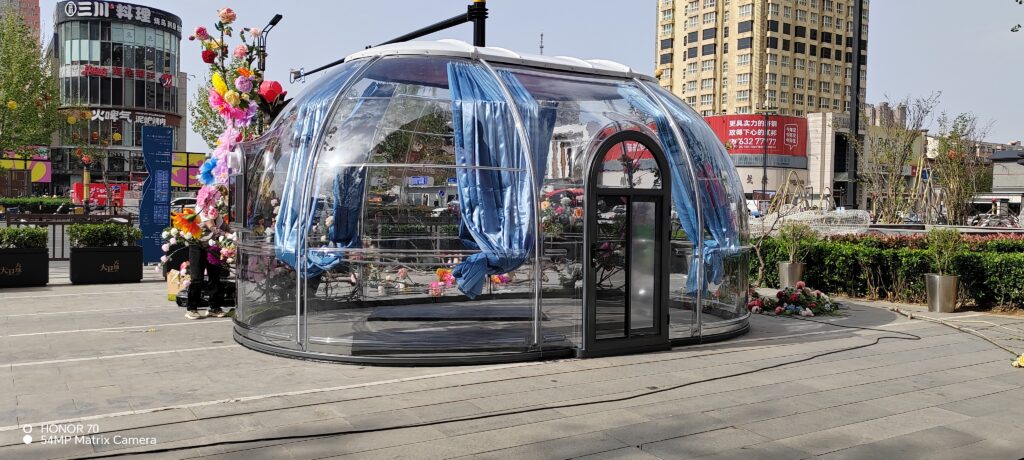
Every glamping developer reaches the same fork in the road: should the site be built on dome houses, yurts, or safari tents? All three rent well, all three photograph beautifully, and all three are sold by manufacturers who claim theirs is the best. The real answer depends on one question: what kind of asset are you building — a structure that keeps earning, or a product that wears out?
This guide compares the three options on the criteria that actually decide a resort’s economics: lifespan, weather resistance, guest experience, shipping, installation, security and the ten-year view.
Dome House vs Yurt vs Safari Tent: The Comparison Table
| Criterion | PC Dome House | Yurt | Safari Tent |
|---|---|---|---|
| Structure lifespan | 10-year frame warranty and 20-year PC panel specification | 5–8 years typical for canvas | 3–5 years before canvas replacement |
| Weather resistance | Rigid shell, published 120 km/h wind and 45 kg/m² snow rating on round models | Good in wind, weaker in heavy snow | Limited; fabric flexes, needs tension care |
| Guest experience | Panoramic transparent views, glasshouse feel | Cosy, warm, traditional character | Classic safari look, open-air veranda style |
| Security | Lockable doors, rigid panels | Moderate; fabric can be cut | Low; fabric perimeter |
| Shipping density | Flat-packs into standard containers; 30 sets of a 4 m dome per 40HQ | Compact when packed | Compact when packed |
| Installation | Hours per unit; 3–5 hours for a 4 m shell with three people | 1–2 days, tensioned fabric | Hours, but needs re-tensioning |
| Maintenance | Low; wipe panels, check seals | Recoat canvas, watch for mildew | Replace canvas every few years |
Lifespan: The Hidden Cost of “Cheaper” Options
Yurts and safari tents cost less per unit than a PC dome house — on paper. But look at the asset over a ten-year operating window. A safari tent needs its canvas replaced roughly every 3–5 years; a yurt needs recoating and careful moisture management. A PC dome house, with its rigid 6063-T5 aluminium frame and UV-coated polycarbonate shell, is specified for a 10-year frame life and a 20-year panel life with a no-yellowing claim, and keeps operating through that window with routine cleaning.
When you annualise the cost — purchase, replacements, and lost booking nights while a unit is out of service — the dome house is frequently the cheaper option, not the expensive one. Replacement is not just a materials invoice: it is a room taken off the market, and in a short season that can cost more than the parts. Our guide to how long a PC dome house lasts breaks down what actually determines panel life.
Weather and Climate Readiness
Dome houses are rigid structures. The shell takes wind and snow as a single engineered system — our round models are published at 120 km/h wind load and 45 kg/m² snow load — which is why Star Series round domes are installed from beachfront resorts to mountain sites. Yurts handle wind well because of their circular shape, but heavy snow loads stress the fabric and lattice. Safari tents are at their best in mild, dry climates; in rain-heavy or snowy regions they demand constant attention.
Climate also decides how many months you can sell. A rigid, sealable shell supports winter operation with heating and thermal coverings, which extends the bookable season; a fabric structure in the same location more often closes for the cold months. Extending a season changes annual revenue capacity far more than a marginal difference in nightly rate.
Guest Experience: What Actually Books at Higher Rates
The dome house has one feature neither a yurt nor a safari tent can match: a fully transparent wall. Guests sleep under a panoramic view of the night sky, which translates directly into higher nightly rates and stronger social media pull — the two things every glamping operator is really selling.
There is a practical edge underneath the romance. Domes are quiet and draught-free in a way that tensioned fabric rarely is, they hold heat with thermal coverings, and a solid lockable door changes how guests judge safety — particularly for couples and families, who are usually the premium booking segment.
Shipping and Installation Reality
All three options ship compactly, so freight is not the differentiator. The differentiator is assembly and handover. A dome house arrives as engineered parts — numbered frame segments and pre-cut panels — and goes up in hours with a small crew: 3–5 hours for a 4 m shell with three people, working up to 5–7 hours for a 6.2 m shell with four to five. It is also a locked, secure structure from day one, while fabric options need tensioning, staking and ongoing adjustment. Our installation guide shows exactly how quickly a dome becomes a rentable unit.
One more shipping point that rarely appears in brochures: because a dome kit flat-packs into standard containers, a multi-unit order can be scheduled in phases. A resort can open with the first batch, start taking revenue, and install the remainder without a second supplier conversation — see the container loading guide for how the densities work.
Foundations and Site Work
Foundations usually decide the real budget, not the unit price. A dome needs a level, load-bearing base — a wooden deck, a concrete pad or ground screws, compared in our foundation options guide — and because the shell is light (around 220 kg for a 4 m round model), all three options remain open, including on sites where heavy structures would need engineered footings.
Fabric structures are more forgiving about slope, but they transfer the problem to tensioning and drainage: a yurt or tent platform still has to be level, and fabric that sits in standing water degrades faster. In practice the site work for all three is comparable; the difference is that the dome’s base is permanent and reusable when the unit is eventually replaced.
Security, Insurance and Guest Trust
Security is the least glamorous criterion and often the decisive one. A rigid shell with lockable doors and impact-resistant panels is a normal hospitality asset to an insurer; a fabric perimeter is a soft target and frequently a line item in the premium. Guests make the same judgement in seconds on arrival — a solid dome reads as a room, while a tent reads as camping, which caps what you can charge and who will book.
When Each Option Actually Makes Sense
- Choose a dome house for long-term resort assets, four-season operation, premium rates, and any site where weather or security matters.
- Choose a yurt for a warm, traditional aesthetic at a lower entry price, if you accept the fabric lifespan and moisture maintenance.
- Choose a safari tent for a light-touch, seasonal operation in a mild climate where canvas replacement is an accepted running cost.
Many successful sites end up mixing: canvas for a seasonal restaurant or lounge, domes for the units that carry the nightly rate. If that is your plan, the sizing questions are covered in the dome size guide, and the revenue arithmetic in our break-even model.
FAQ
Is a dome house better than a yurt?
For a long-term glamping asset, yes: a PC dome house is specified for a 10-year frame life and a 20-year panel life with a rigid, weatherproof shell, while a yurt’s fabric needs recoating and has a shorter lifespan. Yurts win on lower entry price and traditional aesthetics.
How long do safari tents last?
Safari tent canvas typically needs replacement every 3–5 years depending on sun and weather exposure. A PC dome house is specified to keep operating through a full decade with routine cleaning, and panel life on our round models is published at 20 years with a no-yellowing claim.
Can a dome house withstand snow and wind?
Yes. Our round models are published at 120 km/h wind load and 45 kg/m² snow load, carried by a 6063-T5 aluminium frame and UV-protected polycarbonate shell — which is why dome houses are installed on beachfronts, mountains and four-season sites. Compare the figure with your local requirement before ordering.
Why do dome houses rent at higher rates than tents?
The transparent panoramic shell is the unique selling point: guests get a panoramic view and a premium “glasshouse” feel that yurts and safari tents cannot offer. A rigid, quiet, lockable room also attracts the couples and families who book at premium rates.
Is a dome house more expensive than a safari tent?
On unit price, generally yes — a PC dome house costs more up front than a fabric structure. Over a ten-year window the comparison shifts, because canvas replacement cycles and out-of-service nights are recurring costs, while the dome is specified to run through that period with routine cleaning. Ask both suppliers for their ten-year replacement schedule and compare the totals.
Ready to start your dome project?
Talk to our engineers or download the full product catalog first.
Related Posts
 13
Oct 2026
13
Oct 2026
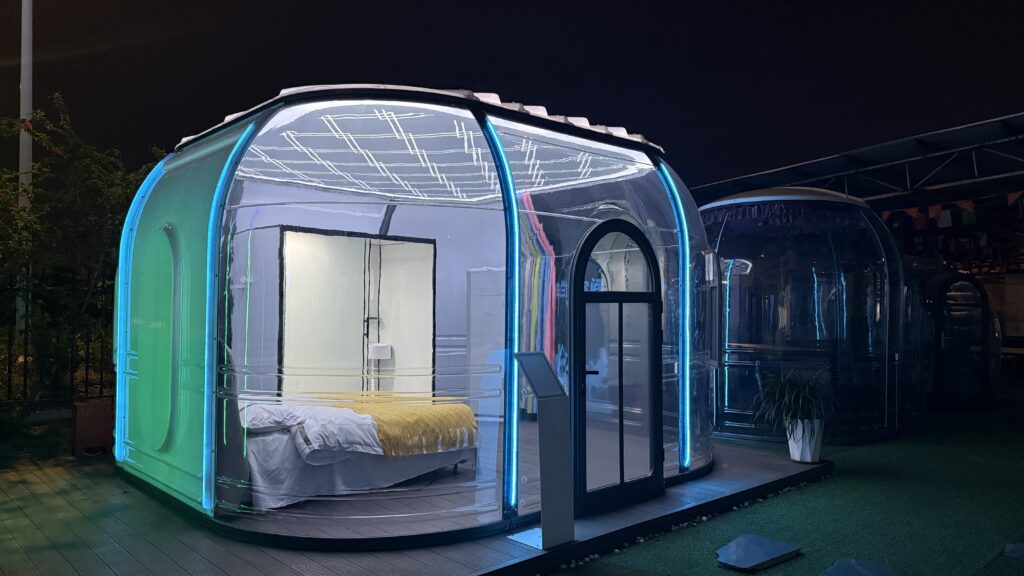
PC Dome vs PVC and Canvas Glamping Tents: A Buyer’s Material Guide
PC dome vs PVC and canvas glamping tents: how the shell material decides lifespan, clarity, weather resistance and what you can build.
View More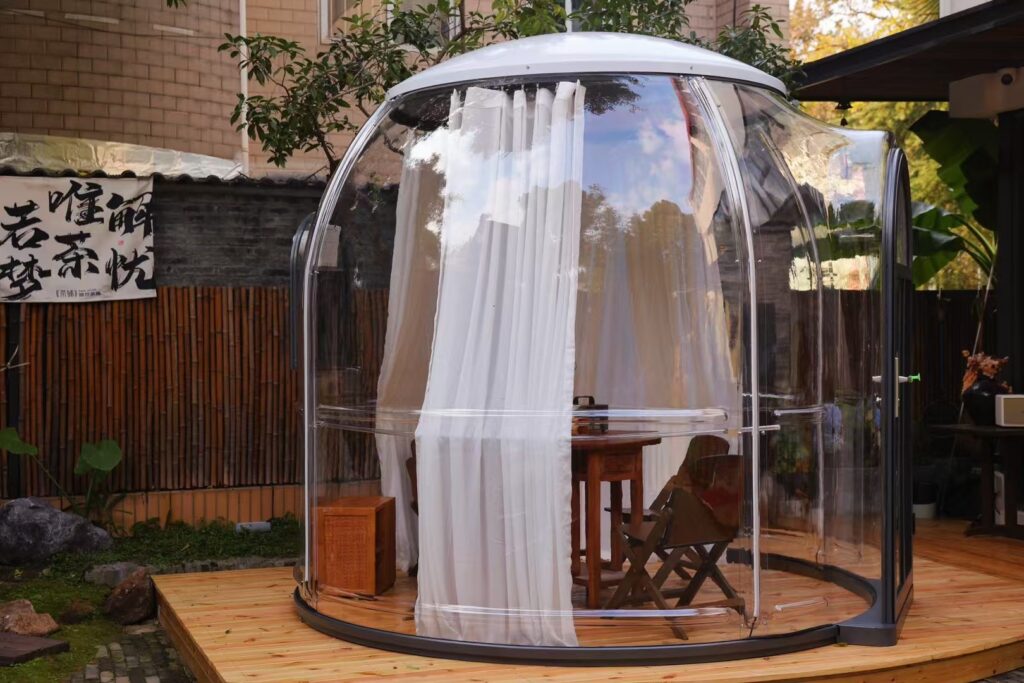 29
Sep 2026
29
Sep 2026
Dome House for Backyard Glamping: How to Plan Your First Unit
Dome house for backyard glamping, planned properly: right size, level base, power, heating and what one unit needs before delivery day.
View More