
PC Dome vs PVC and Canvas Glamping Tents: A Buyer’s Material Guide
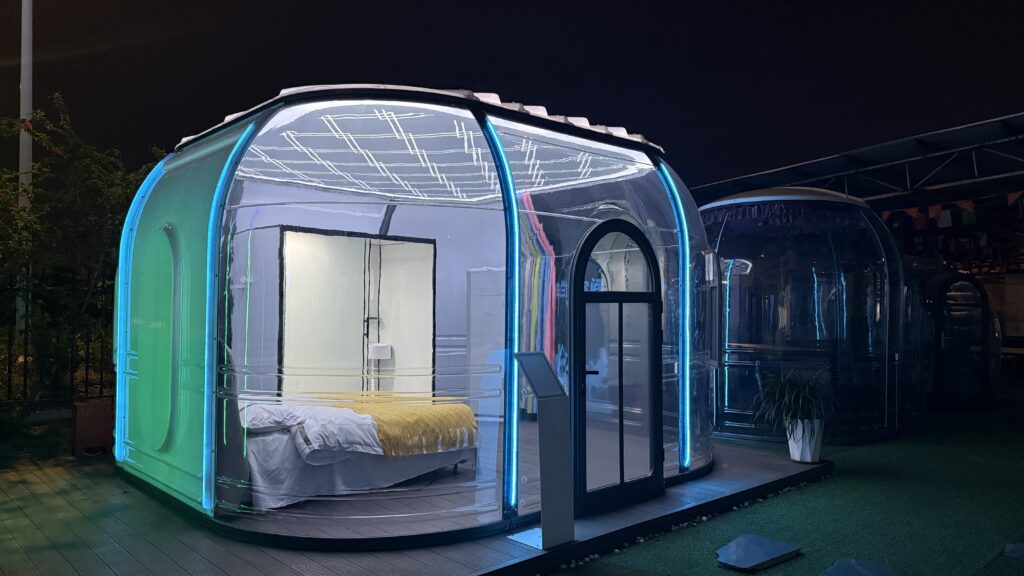
Most buyers shopping for a clear glamping structure start by comparing shapes. The shape is the easy part. What decides whether your unit is still earning in year eight is the shell material — and the two categories behave nothing alike.
This guide compares a rigid polycarbonate dome with the flexible options usually quoted against it: clear PVC tents and coated canvas tents. It focuses on structure, weather, sealing, maintenance and freight rather than looks.
What each material actually is
Polycarbonate (PC) dome. A factory-formed panel of polycarbonate — a rigid engineering plastic — held by a structural aluminium frame. The panels we ship are 3 mm polycarbonate on ZH270, ZH350, ZH400 and ZH510, and 3.5 mm on ZH620, with a UV-protective layer co-extruded into the sheet. Thicker panels (3.5–4.5 mm, or 4–4.5 mm on ZH620) can be specified. The frame is 6063-T5 aluminium, powder-coated.
Clear PVC tent. A flexible transparent membrane — usually PVC film laminated to a reinforcing scrim — stretched over a steel or aluminium tube frame, or held up by continuous air pressure in an inflatable version. Nothing about the membrane is self-supporting.
Coated canvas tent. A woven fabric (cotton/polyester) sealed with a coating for waterproofing. Opaque by design, so it delivers no view at all unless a separate clear window is sewn in.
Structural behaviour: self-supporting versus frame-dependent
It drives everything downstream.
A dome shell carries its own load. The curved geometry is inherently rigid, so the panels and frame form one continuous surface with no guy lines, no tensioning and no blower. Once it is assembled, the structure stands on its own.
A flexible membrane does not. A PVC or canvas tent must borrow its shape from something else: a tube frame that has to be anchored and tensioned, or an air blower that must run continuously to keep the envelope inflated. That has consequences beyond the tent itself — a blower means a permanent power draw and a structure that deflates if power fails, and a tube frame means visible ribs, more anchor points, and a shape you cannot fully seal.
Weather: wind, snow and impact
Our round models are published at 120 km/h wind load and 45 kg/m² snow load — a structural rating for the assembled shell, not a fabric tensile strength.
Snow behaves differently on the two categories. On a dome, the curve sheds snow; there is no flat roof plane for it to accumulate on. On a tent, snow sits on the membrane, and a wet snow load is exactly the condition that collapses tube-frame tents — which is why tent suppliers publish “take the snow off” instructions rather than a snow rating.
Impact is the other divider. A rigid polycarbonate panel resists hail and thrown debris as a sheet. A thin clear PVC film punctures and tears; a small hole in a membrane is a leak, whereas the same event has no equivalent failure mode on a panel.
Light and clarity over time
Clear is not a permanent state for every transparent material. PVC film yellows and hazes as it is exposed to UV, which is why clear tents look noticeably different after a few seasons — the view degrades even though the structure still stands.
Polycarbonate deals with this differently: the UV protection is a layer in the sheet itself, and our panels carry a 20-year warranty against yellowing, with a 10-year warranty on the frame. One product warrants its clarity for two decades; the other cannot.
Comfort inside the unit
Both a rigid panel and a membrane are single-skin, so neither is a substitute for real insulation. The difference is in the details around them.
A hard shell with framed doors and windows closes properly. That matters for three guest complaints that decide reviews: condensation, insects and noise. A tensioned membrane, by contrast, has seams, tie-downs and gaps at the base, and condensation on the inside face of a cold membrane is a normal occurrence, not a fault. Add the hum of a blower and the indoor experience differs in kind, not degree.
Where a dome needs help, the fix is ventilation rather than material — our own guides cover cooling a dome in hot climates and heating one through winter. Both are specified through the same frame: every model ships with exhaust vents, and skylight exhaust fans, air-conditioning bases, motorised overhead curtains and thick blackout curtains (20 colours) are available as options.
| Property | Rigid PC dome | Clear PVC / canvas tent |
|---|---|---|
| Shell | Rigid polycarbonate panels, 3–3.5 mm as standard | Flexible film or coated fabric |
| Self-supporting | Yes — frame and panels form one shell | No — needs frame tensioning or a running blower |
| Shape memory | Fixed curved geometry | Depends on tension or air pressure |
| Snow behaviour | Curve sheds snow; rated 45 kg/m² | Snow sits on the membrane |
| Clarity over time | UV layer in the sheet; 20-year no-yellowing warranty | PVC hazes and yellows with UV exposure |
| Puncture / hail | Resists as a rigid sheet | Film punctures and tears |
| Sealing | Framed doors and windows close tight | Seams, tie-downs and base gaps |
| On-site assembly | 2–5 people, 2–7 hours depending on model | Frame or blower commissioning, then tensioning |
Lifespan and what you actually maintain
Maintenance differs more than the purchase decision suggests. A rigid dome is inspected rather than serviced: check seals, hinges and fixings, clean the panels, confirm the frame coating is intact. There is no re-tensioning cycle and no blower to fail.
A flexible tent has consumables. Membranes are replaced rather than repaired, seams are re-sealed, frames are re-tensioned, and inflatable units add a blower to the maintenance list. Over a ten-year holding period that is a different ownership model — which is why we keep a separate guide on how long a PC dome house lasts and what to inspect each year.
Freight, handling and installation
Rigid does not mean unshippable. Domes ship knocked down as flat-packed panels and frames, which is why container loading is quoted in sets. Current published 40HQ loading is 40 sets for ZH270 (2.7 m), 30 sets for ZH350 (3.5 m), 30 sets for ZH400 (4.0 m), 24 sets for ZH510 (5.1 m) and 16 sets for ZH620 (6.2 m). On a 3.5 m or 4 m model that is a container holding thirty complete units.
Assembly is a small-crew job: 2 workers for around 2 hours on ZH270, rising to 4–5 workers over 5–7 hours on ZH620. No crane is required for the round models, and no blower commissioning is involved.
Where a tent still wins
A flexible tent remains the better answer when the requirement is genuinely temporary — a one-season festival bar, a site you expect to relocate. It is also lighter to move by hand and packs into a smaller volume for short-notice moves.
What it is not is a permanent transparent room. If the plan is a unit that has to keep its view, hold a snow load and close properly year after year, the shell material has already decided the outcome.
FAQ
Is a PC dome heavier than a canvas or PVC tent?
Yes, and it matters for freight rather than for installation. A rigid dome is moved as flat-packed panels and an aluminium frame in a crate, which is why capacity is quoted in sets per 40HQ container — 30 sets on ZH400, 16 on ZH620. A membrane tent packs smaller per unit but has to be moved with its own frame or blower.
Can a clear PVC tent be as transparent as a polycarbonate dome?
When new, both are clearly transparent. The difference appears with UV exposure: PVC film hazes and yellows over time, whereas the UV protection in our panels is part of the sheet and carries a 20-year warranty against yellowing. If long-term clarity is the point of the project, that difference decides it.
Which one handles snow better?
A dome, because of geometry. Our round models are published at 45 kg/m² snow load and 120 km/h wind load, and the curved surface sheds snow rather than holding it. A membrane tent has no flat-roof shedding behaviour — snow sits on the fabric, which is why tent guidance is to clear it manually.
Do I need a blower or power supply to keep a dome up?
No. A dome is self-supporting once assembled — the frame and panels form the structure, so there is no continuous air pressure to maintain and nothing deflates if power is interrupted. That also means a power cut affects lighting and climate control, not whether your building is standing.
Which models should I compare first?
Work from the guest count and the site. Our dome size guide walks through the 2.7 m to 6.2 m range, and for a first unit most operators sit between the 4 m and 5.1 m models. If you are weighing a hard shell against a membrane for the same plot, see our ZH400 page for the full published specification before you compare quotations.
Ready to start your dome project?
Talk to our engineers or download the full product catalog first.
Related Posts
 29
Sep 2026
29
Sep 2026
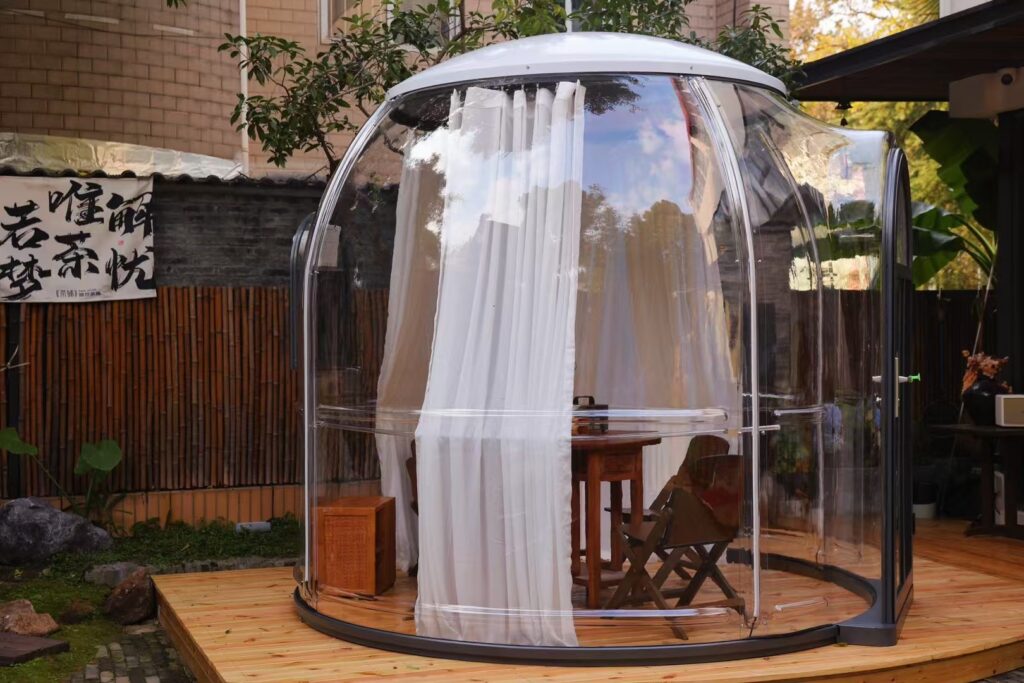
Dome House for Backyard Glamping: How to Plan Your First Unit
Dome house for backyard glamping, planned properly: right size, level base, power, heating and what one unit needs before delivery day.
View More 22
Sep 2026
22
Sep 2026
Dome House Cost per Square Meter: Why Size Changes the Ratio
Why dome house cost per square meter falls as diameter grows - what belongs in the ratio, what to exclude, and how to compare supplier quotes fairly.
View More