
Dome House Cost per Square Meter: Why Size Changes the Ratio
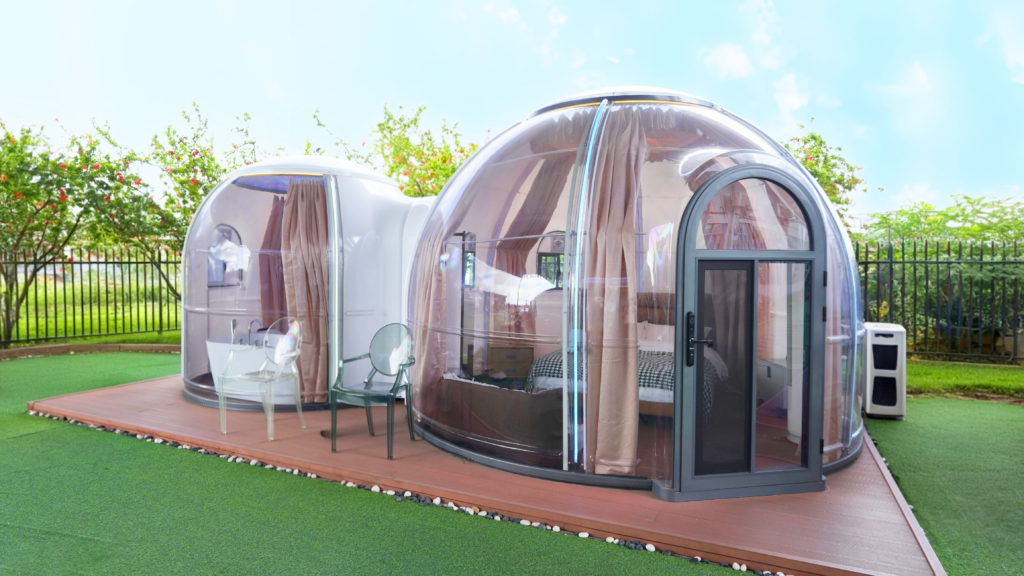
Nearly every first enquiry to a dome factory asks the same question: what does it cost per square metre? It is the quickest way to test an unfamiliar quotation against a budget you already hold. It is also the number most often compared unfairly, because a dome house’s cost per square meter is not a fixed rate — it falls as the dome gets bigger.
This guide explains what belongs inside that ratio, how it behaves across our round range from 2.7 m to 6.2 m, and how to compare quotations fairly.
Why Buyers Ask for Cost per Square Meter
When you are evaluating three factories at once you need one normalising number. Floor area is the obvious denominator: it is published on every product page and it scales with what you actually sell — guest nights. The problem is the numerator. One supplier quotes a bare shell, another a shell with flooring, air-conditioning preparation and lighting, a third adds freight to your port. Divide three different scopes by the same floor area and you get three numbers that look comparable and are not.
The ratio is still useful — it just has to be built in the right order. Agree the scope first, then divide.
What Belongs in the Ratio — and What Doesn’t
Inside a standard round Star Dome quotation you will normally find the shell structure — powder-coated 6063-T5 aluminium frame with UV-protected polycarbonate panels — plus the opening package of door, windows, blackout curtain and exhaust fan. The opening count grows with the model: one window on the 2.7 m and 4 m units, two on the 5.1 m, three on the 6.2 m. Any factory options you select sit inside the figure too.
Outside it you will normally find three things:
- Packing and freight. Crating, inland haulage and sea freight are separate line items — see dome house shipping cost.
- Site work. Foundation or deck, electrical connection, water and wastewater — see foundation options.
- Local labour and equipment hire for unloading and assembly.
The most common error is comparing a bare shell from one factory with a fully optioned unit from another. The gap is usually the accessories, not the shell.
The Size Effect: Why the Ratio Falls as Domes Grow
Inside any dome, a set of components is close to fixed however large the shell becomes: one door set, one exhaust fan, one curtain rail, the same frame profile per panel row, one export crate. On a 5.7 m² unit those items dominate the total; on a 30 m² unit they nearly vanish into it. The table below divides each model’s real net weight and real single-set crate volume by its real floor area.
| Round model | Floor area | Net weight | Weight per m² | Export crate (1 set) | Crate volume per m² |
|---|---|---|---|---|---|
| ZH270 · Φ2.7 m | 5.7 m² | ≈ 135 kg | 23.7 kg/m² | 5.5 m³ | 0.96 m³/m² |
| ZH350 · Φ3.5 m | 9.6 m² | ≈ 160 kg | 16.7 kg/m² | 6.47 m³ | 0.67 m³/m² |
| ZH400 · Φ4.0 m | 12.5 m² | ≈ 220 kg | 17.6 kg/m² | 7.74 m³ | 0.62 m³/m² |
| ZH510 · Φ5.1 m | 20.4 m² | ≈ 295 kg | 14.5 kg/m² | 9.9 m³ | 0.49 m³/m² |
| ZH620 · Φ6.2 m | 30.17 m² | ≈ 400 kg | 13.3 kg/m² | 12.58 m³ | 0.42 m³/m² |
Material intensity falls sharply with size. Weight per square metre drops from 23.7 kg/m² on the 2.7 m unit to 13.3 kg/m² on the 6.2 m unit — roughly 44% less aluminium and panel content per square metre. The smallest dome is not a scaled-down version of the largest; it carries proportionally far more door, frame and hardware per square metre of usable space.
The curve is not perfectly smooth. The 4 m unit is slightly heavier per square metre than the 3.5 m, because both share the same one-door, one-window configuration while the shell grows faster than the opening package. That non-linearity is why a single flat rate cannot be applied across a range — and why a supplier quoting one rate for every size is almost certainly quoting a different scope.
Panel Thickness and Options Move the Ratio
Standard round panels are 3 mm UV-protected polycarbonate, and the 6.2 m model is built with 3.5 mm. Where a site needs more rigidity or a colder climate calls for it, custom thickness is available: 3.5–4.5 mm across the round range, 4–4.5 mm on the 6.2 m. Thicker sheet is a genuine cost increase per square metre, and one legitimate reason two otherwise identical quotations differ.
The opening package does the same. Every extra window, casement, awning or entry point adds hardware and labour but no floor area, so two 4 m domes with different window counts are the same size and not the same price per square metre. Fix the opening schedule before comparing rates.
Freight Is Where per-Square-Metre Comparisons Break Down
Sea freight is priced on volume for LCL and on whole containers for FCL, so the governing figure is crate volume divided by floor area. On the same table it falls from 0.96 m³ per square metre on the 2.7 m unit to 0.42 m³ on the 6.2 m — about 56% less. Larger domes therefore get a double benefit: less material and less shipping volume per square metre. Mixed orders compound it, because units can be nested and packed together instead of shipping as single-set crates.
This is where a naive comparison fails hardest: an ex-works quotation and a delivered quotation are not the same ratio. Keep the freight line visible and separate — if it is buried inside a rounded per-square-metre figure, you cannot tell which order is cheaper.
How to Compare Two Quotes on Equal Scope
- Match the diameter exactly. A 4 m dome against a 4 m dome — not a 3.5 m against a 4 m “close enough”.
- Match the panel specification. Confirm thickness and UV protection in writing on both quotations.
- Match the opening package. Same door, same window count, same curtain and exhaust provision.
- Match the option list. Flooring kit, air-conditioning preparation, lighting, locks and awnings are the usual silent differences.
- Match the Incoterm. Ex-works, CIF and DDP prices are not the same number.
- Divide only after all five steps match — then note what each side excluded.
Worked Example: A 4 m Unit Against a 6.2 m Unit
The 4 m unit has 12.5 m² of floor area, about 220 kg net weight and a 7.74 m³ crate. The 6.2 m unit has 30.17 m², about 400 kg and a 12.58 m³ crate. Moving up multiplies floor area by about 2.4, net weight by about 1.8 and crate volume by only about 1.6. You buy far more usable space per kilogram of material and per cubic metre of freight. That is the structural reason the larger dome carries a lower cost per square metre, in any currency.
It is also why we do not publish a single rate per square metre. An honest figure has to be attached to a specific model, panel thickness, opening schedule and Incoterm — otherwise it is a marketing number, not a quotation.
FAQ
How much does a dome house cost per square meter?
There is no single rate, because cost per square metre falls as the dome grows. Doors, windows, fans, frame rings and crating are near-fixed per unit while floor area expands roughly with the square of the diameter. Across our round range, material content per square metre falls by about 44% and shipping volume per square metre by about 56% between the 2.7 m and 6.2 m models. Send us your model, panel thickness and opening schedule and we will return a line-item quotation you can normalise yourself.
Is a bigger dome cheaper per square meter?
Yes, within the same product family and specification. A 6.2 m unit carries about 13.3 kg of structure per square metre against 23.7 kg for a 2.7 m unit, and occupies 0.42 m³ of crate volume per square metre against 0.96 m³. The advantage is real but not proportional, and it stops being decisive once a dome is large enough to need heavier frame profiles and thicker panels.
Does cost per square meter include shipping and installation?
Usually not. Crate volume, inland haulage and sea freight are normally quoted separately, and site work — foundation, electrical connection, water and wastewater — is almost always the buyer’s scope. If a supplier folds everything into one per-square-metre figure, ask for the breakdown before comparing it with anyone else’s quote.
Why do two suppliers quote very different prices per square meter?
In practice the gap usually comes from four things: panel thickness and UV coating, the number of doors and windows, the accessory package included, and the Incoterm. A bare shell and a fully optioned unit of identical diameter can differ substantially before freight is added. Compare line items, not headline rates.
Which size gives the best value per square meter?
Value depends on how you will use the space, not on the ratio alone. The 4 m unit is our best-selling single unit for glamping sites, restaurants and backyards, and balances floor area against weight and crate volume well. The 6.2 m unit wins on ratio but only pays off when you can fill the extra space with paying guests. Review the full Star Series range, or compare the 4 m ZH400 and 6.2 m ZH620 pages side by side, and we will help you work out which fits your site and your rate card.
Ready to start your dome project?
Talk to our engineers or download the full product catalog first.
Related Posts
 13
Oct 2026
13
Oct 2026
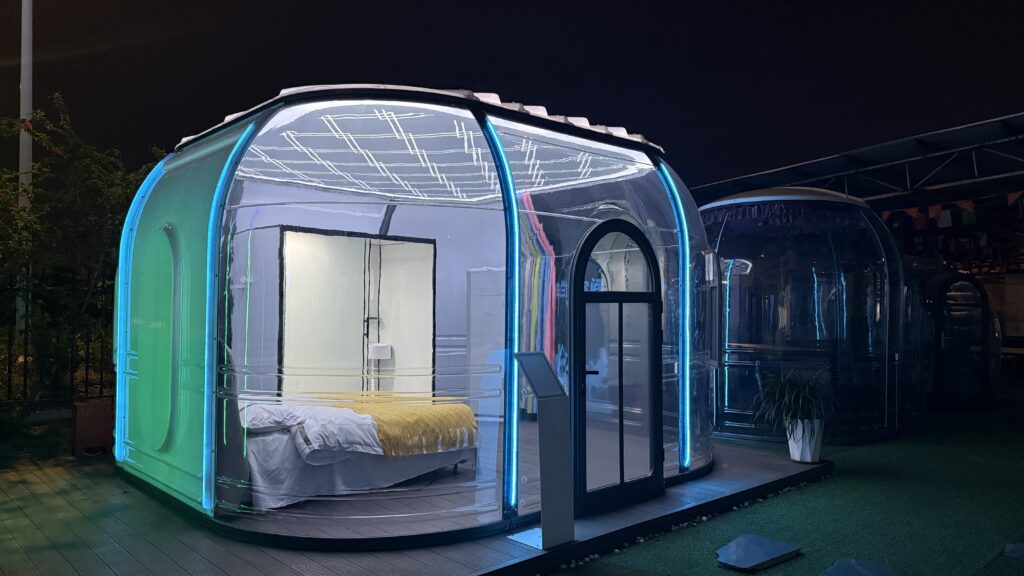
PC Dome vs PVC and Canvas Glamping Tents: A Buyer’s Material Guide
PC dome vs PVC and canvas glamping tents: how the shell material decides lifespan, clarity, weather resistance and what you can build.
View More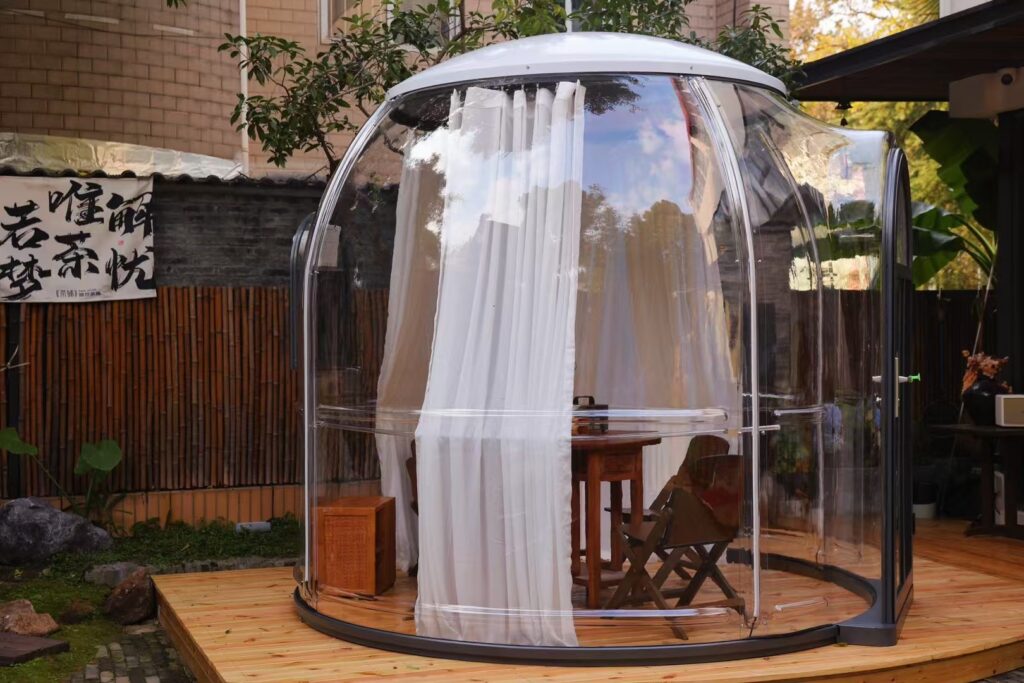 29
Sep 2026
29
Sep 2026
Dome House for Backyard Glamping: How to Plan Your First Unit
Dome house for backyard glamping, planned properly: right size, level base, power, heating and what one unit needs before delivery day.
View More