
Geodesic Dome vs Round Dome: Which Structure Wins for Glamping

Search “dome house” and two very different structures appear under the same word: the geodesic dome — a faceted ball of triangular struts — and the round dome, a smooth, continuous shell. Both are marketed for glamping and both claim to be “the dome”, but they are built differently, cost differently and fail differently. Here is the buyer’s guide to choosing between them.
Geodesic Dome vs Round Dome: What Is the Difference
A geodesic dome is built from a network of short struts forming triangles that distribute load across the whole sphere. A round dome (also called a single-curvature or spherical-cap dome) is made of large, pre-formed panels that sit on a ring frame, forming one continuous smooth surface.
You can tell them apart instantly: the geodesic looks like a white faceted ball, while the round dome looks like a smooth transparent igloo or bubble. The difference is not cosmetic. In a geodesic, the structure is the frame — every strut and hub is visible from inside, and every triangle is a separate piece of skin. In a round dome, the frame is a small number of curved profiles that the panels span across.
Appearance and the Glamping Experience
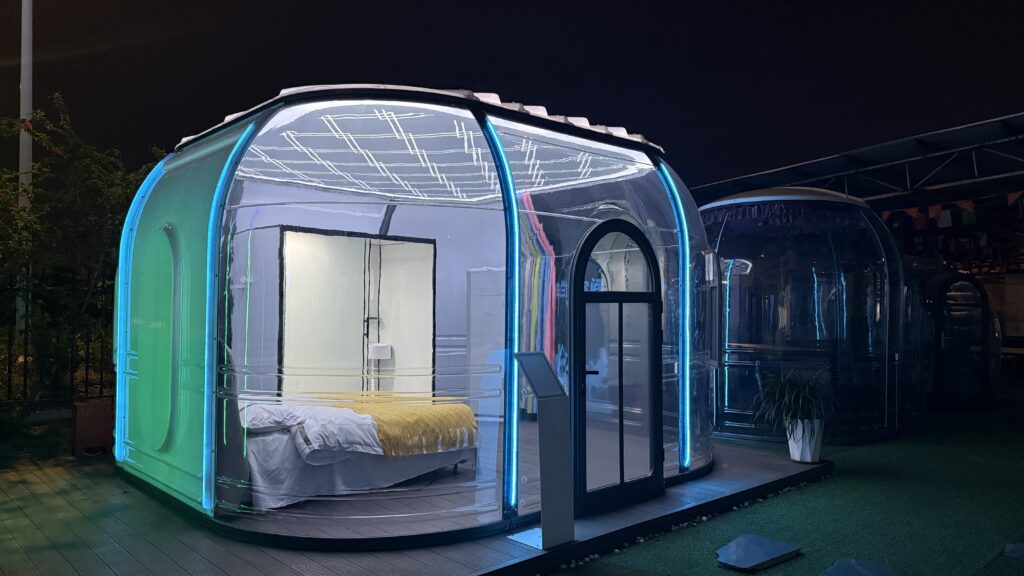
This is where the two diverge most for a resort operator. A round dome with transparent polycarbonate panels gives guests an unbroken panorama — the entire sky in one continuous sheet. A geodesic’s frame is a dense grid of struts and hubs, and its panels are small triangles, so the view is broken into segments and the interior feels busier.
For glamping, where the product is the view, the smooth transparent shell of a round dome is a genuine commercial advantage. Guests do not just sleep in a dome — they sleep inside the landscape.
There is a quieter difference that operators notice after the first season. A round shell is transparent down to floor level, so the bed sits inside the view. On many glamping geodesics the lower courses of triangles are solid or opaque, and an inner lining is often added for insulation — which costs you part of the panorama you paid for.
Side by Side: The Comparison Table
The table below contrasts the common glamping geodesic kit with the round shell we build. Engineered geodesics exist that outperform this pattern — but at a price point most glamping projects do not reach.
| Geodesic dome (common glamping kit) | Round dome (STAR DOME) | |
|---|---|---|
| Structure | Short struts joined by hubs into a triangulated sphere | Large pre-formed panels spanning a ring frame |
| What guests see | Segmented by the visible strut grid | Continuous panorama to floor level |
| Skin | Small triangular panels, often with a fabric cover or lining | 3–3.5 mm UV-protected polycarbonate |
| Joints to seal | Hundreds of strut-to-hub connections | A few frame lines where panels meet |
| Frame | Steel or timber struts with hubs | 6063-T5 powder-coated aluminium |
| Weather rating | Depends on the kit’s engineering | 120 km/h wind · 45 kg/m² snow load |
| Warranty | Supplier-dependent | 10 years frame · 20 years PC panel |
| Best suited to | Large spans, event halls, faceted-look brands | Nightly-rented glamping units and clusters |
Structural Differences That Affect Your Site
- Joint count: a geodesic has hundreds of strut-to-hub connections; a round dome has a fraction of them. Fewer joints means fewer leak points and easier maintenance over a decade.
- Panel size: round dome panels are large, pre-formed sections that install quickly; geodesic panels are small triangles that must each be fitted and sealed.
- Wind and snow: both can be engineered for real loads, but a round dome’s smooth surface sheds wind and snow more predictably than a faceted surface with exposed joints.
Installation: Large Panels vs Hundreds of Joints
Installation is where the two structures separate in labour terms, and it is the cost most often underestimated at quotation stage. A round shell is assembled as a sequence: ring frame, frame rings, panels, then openings and finishing. Our 5-step installation process runs on a small crew with hand tools and no crane:
- 2.7 m unit: 2 workers, about 2 hours
- 3.5 m unit: 2–3 workers, about 3 hours
- 4 m unit: 3 workers, 3–5 hours
- 5.1 m unit: 3–4 workers, 3–5 hours
- 6.2 m unit: 4–5 workers, 5–7 hours
A geodesic is assembled part by part — struts, hubs and triangles — with every connection made, aligned and sealed on site. That work is measured in days rather than hours for a comparable unit, and it depends heavily on the quality of the local crew. Whatever the shell stands on, our foundation options cover deck, concrete pad and ground screws.
Cost and Manufacturing Reality
A geodesic dome is made of many identical small parts, which can make the raw material cheap. But that advantage evaporates in assembly: hundreds of connections, longer on-site labour, and more sealant to maintain. A round dome concentrates cost in the pre-formed panels and the ring structure — precision manufacturing in the factory, simplicity on site.
The material story shows up in the shipping data: a 2.7 m unit weighs about 135 kg net and ships in a 5.5 m³ crate, while the 6.2 m flagship is about 400 kg net in a 12.58 m³ crate. For a factory-direct buyer comparing installed cost rather than ex-works price, the round dome usually wins on labour, installation speed and maintenance — the economics of that comparison are set out in what a dome house price actually covers.
Maintenance Over a Decade
Both structures need attention; they need different kinds of it. On a geodesic, the list is dominated by connections: re-sealing hub joints, checking strut fixings, and inspecting the cover or lining, which is a wear item replaced periodically. Every joint is also a potential water path, and finding the one that has started to leak is slow work.
On a round shell the recurring work is simpler: inspect the panel seals and gaskets, clean the polycarbonate, and check the door and window hardware. The frame is powder-coated aluminium and the panels are UV-protected against yellowing — which is why we warrant the frame for 10 years and the panel for 20.
Where a Geodesic Still Makes Sense
Being clear about this matters more than defending one design. A geodesic is the better answer when the span is very large — for event halls well beyond 10 m, triangulated structure covers ground efficiently and keeps panel sizes manageable. It is also right when the faceted look is the brand, or when you need the lowest-cost pilot unit before you know whether the site works.
For a unit you rent nightly, though, the round shell wins on the two numbers that decide the business case: what guests pay for the view, and what it costs to keep it weathertight.
Why STAR DOME Uses Round Construction
We build every model in our Star Series and Moon Series as a smooth round shell for three reasons: unbroken panoramic views for guests, a structural frame with minimal joints for weatherproofing, and fast large-panel installation for our customers’ projects. The result is a product optimised for the two things a glamping asset needs most — nightly rate and operating cost.
The range runs from the 2.7 m entry unit to the 6.2 m flagship, all sharing the same frame system, panel specification and opening package, so a site can mix sizes without mixing suppliers. Compare the 4 m unit and the 6.2 m unit if you are sizing a first cluster.
FAQ
What is the difference between a geodesic dome and a round dome?
A geodesic dome is built from hundreds of triangular struts and hubs forming a faceted ball, while a round dome is one smooth continuous shell made of large pre-formed panels. Round domes offer unbroken panoramic views, fewer joints and faster installation.
Which dome is better for glamping?
For glamping, a round dome is generally better: the smooth transparent shell gives guests a full panoramic view to floor level, has fewer leak points to maintain, and installs in hours rather than days. A geodesic remains the better choice for very large spans, or where the faceted look is the concept.
Are geodesic domes cheaper than round domes?
Geodesic kits can look cheaper per part, but total installed cost — hundreds of joints, longer labour, more sealant to maintain — usually erases the advantage. Round domes concentrate precision in the factory and keep on-site work simple.
Which dome is stronger in wind and snow?
Both can be engineered for high loads. A round dome’s smooth surface sheds wind and snow more predictably than a faceted surface with exposed joints, and with far fewer seals to maintain. Our round units are rated to 120 km/h wind and 45 kg/m² snow load, with site-specific requirements confirmed against your local conditions before order.
Do round domes need a special foundation?
No — a round shell sits on a ring frame that can be fixed to a wooden deck, a concrete pad or ground screws, so the foundation follows the terrain rather than the product. What matters is that the bearing surface is level and rated for the unit’s weight. See dome house foundation options for the trade-offs.
Ready to start your dome project?
Talk to our engineers or download the full product catalog first.
Related Posts
 13
Oct 2026
13
Oct 2026
PC Dome vs PVC and Canvas Glamping Tents: A Buyer’s Material Guide
PC dome vs PVC and canvas glamping tents: how the shell material decides lifespan, clarity, weather resistance and what you can build.
View More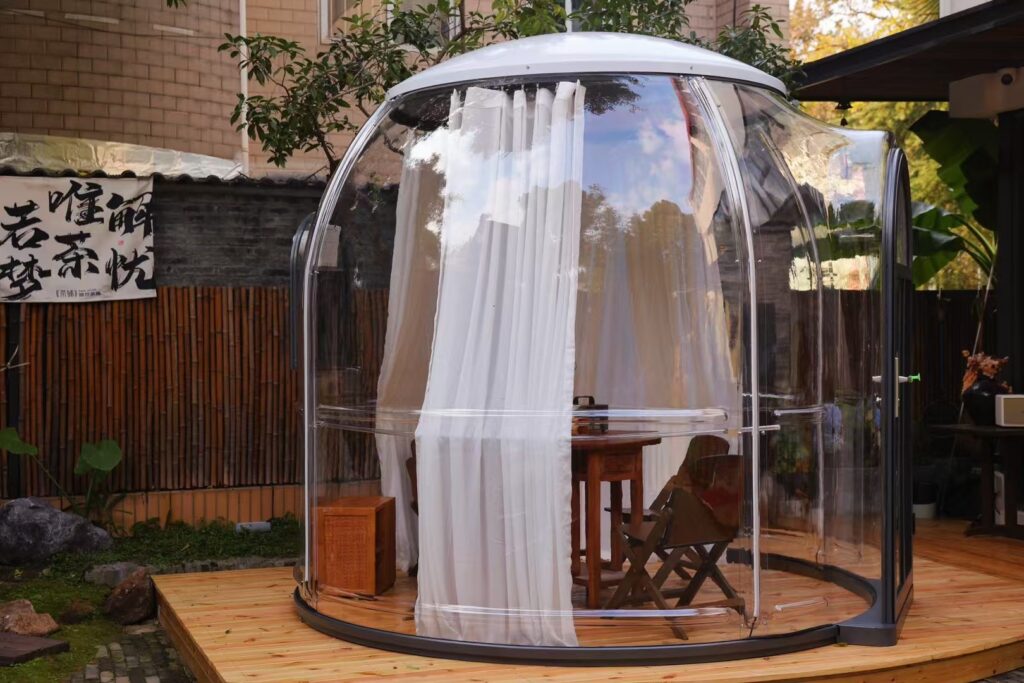 29
Sep 2026
29
Sep 2026
Dome House for Backyard Glamping: How to Plan Your First Unit
Dome house for backyard glamping, planned properly: right size, level base, power, heating and what one unit needs before delivery day.
View More