PC Dome vs Glass Dome: The B2B Buyer’s Comparison
For B2B buyers, the glass-versus-polycarbonate decision for a transparent dome comes down to four questions: cost, weight, breakage risk and freight volume. Get those four right and the rest — appearance, maintenance, longevity — follows logically. This side-by-side is written for buyers comparing quotes, not for architects chasing a single material preference.
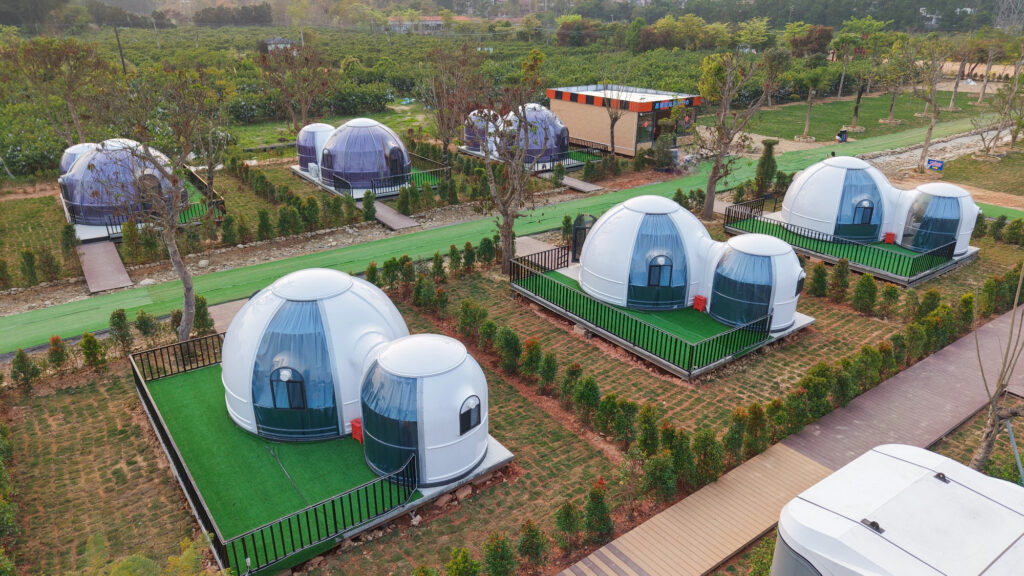
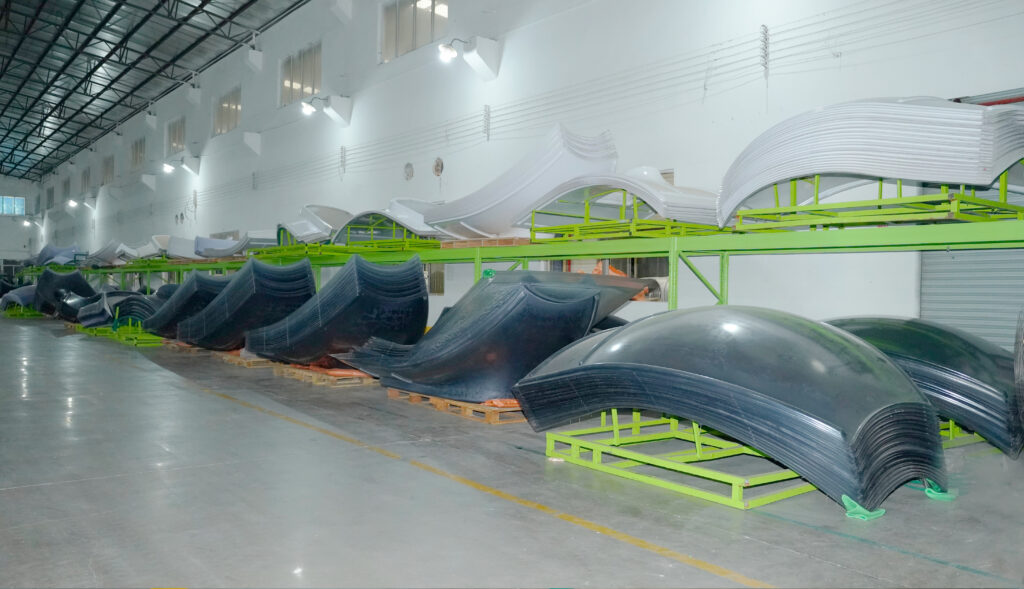
The starting point is what we actually build. Across the round, oval, capsule and square ranges, the shell is polycarbonate with a UV-protective coating, carried on a 6063-T5 powder-coated aluminium frame: 3 mm panels on the 2.7 m, 3.5 m, 4 m and 5.1 m round models, and 3.5 mm on the 6.2 m. Transparent glass shells are not part of the standard range, for the reasons below.
Cost per Square Metre
Thickened polycarbonate costs a fraction of tempered glass at equivalent transparency. The gap is large enough that it changes the business case: a full-glass dome shell would price a glamping unit out of its market segment, while a PC shell keeps the build affordable at resort scale. If you are comparing quotes from different suppliers, check which material is actually specified — a “glass look” dome at a suspiciously low price is almost certainly PC, and that is usually good news.
Cost also compounds through the rest of the project. A heavier shell needs a heavier foundation, more lifting equipment and more labour hours per unit, so the material decision quietly sets your civil works budget as well as your unit price.
Weight and Handling
Polycarbonate is substantially lighter than glass of the same area, and that single property drives three practical consequences: lower freight cost per container, no heavy lifting equipment on site, and safer handling by a small local crew. Our round shells illustrate the scale of what a crew actually moves — approximately 135 kg for the 2.7 m, 160 kg for the 3.5 m, 220 kg for the 4 m, 295 kg for the 5.1 m and 400 kg for the 6.2 m, and that is the assembled structure including frame, not one panel. A glass panel is a specialist logistics problem; a PC panel is something two workers can carry up a slope.
The same property keeps the foundation simple. Because the shell is light, a wooden deck or ground screws are viable in places where a glass structure would demand a concrete pad designed for far greater dead load.
Breakage and Logistics
PC survives handling, shipping and site bumps that would crack glass. Panels flex rather than shatter, which matters twice: once during the container journey and again during installation on a site full of ladders and tools. For international buyers, this is the difference between receiving panels as specified and running a breakage-claims process across an ocean.
There is a second, less obvious advantage: a breakage claim on a transparent shell is not only a cost, it is a schedule risk. Every replacement panel has to be manufactured, crated and shipped before the unit can open. A material that tolerates rough handling removes a whole category of delay from your opening plan.
Clarity, UV and Long-Term Appearance
The material trade-off is real. Glass offers the highest clarity and the hardest surface, so it resists scratches better over time. PC panels carry a UV-resistant coating that keeps them from yellowing, but that coating is the part that determines appearance over the years — which is exactly why you should ask every supplier for the UV coating specification in writing. On our round models the panel specification is published as a 20-year PC panel with a no-yellowing claim, backed by a 10-year frame warranty; the reasoning behind those numbers is set out in our guide to how long a PC dome house lasts.
For the overwhelming majority of dome applications — glamping units, resort rooms, dining pods — PC clarity is more than sufficient, and the total cost of ownership over a decade favours PC decisively. Glass earns its place where surface hardness and scratch resistance are the priority, typically on prestige architectural facades rather than on resort units that get cleaned, inspected and occasionally bumped by guests.
Thermal Behaviour and Condensation
Material choice also changes how the room feels. A single-glazed transparent shell — whichever material it is made from — loses heat at night and collects solar gain by day, which is why insulation strategy matters more than the panel itself. In cold climates the practical answer is thermal covering: thick blackout curtains (available in 20 colours) and a correctly sized heating unit mounted on the base we supply. In hot climates the order reverses and shading comes first.
Condensation is the failure mode to design out in either climate. Warm, moist air meeting a cold shell condenses on the panels, and the remedy is deliberate airflow rather than a different material — one exhaust is fitted as standard on the 2.7 m, 3.5 m and 4 m models, three on the 6.2 m, and a skylight exhaust fan is available as an option. Our winter-proofing and ventilation guides cover both ends of the climate range.
Maintenance Over a Decade
Routine maintenance for a PC dome is simple: wipe the panels, check the seals, inspect the frame. There is no gasket replacement schedule, no panel re-sealing campaign, and no breakage budget line. The panels arrive pre-cut and clip into the aluminium profiles, so an individual panel can be replaced without dismantling the shell — a maintenance task a local crew can handle.
Glass, by contrast, brings a higher replacement cost per panel, requires careful handling for any replacement, and carries the ongoing risk of thermal stress in extreme climates. Over a ten-year operating window, the maintenance line is where the material gap compounds.
The Pragmatic Path for Most Operators
For a transparent hospitality structure, the pragmatic answer is a PC shell: cost, weight, breakage tolerance and freight volume all point the same way, and the appearance guests are paying for — a panoramic transparent wall and a clear night-sky view — is delivered in full. Where a project wants a different visual treatment at a specific point, the practical route is to vary the frame finish and panel thickness rather than the glazing material: PC panels can be specified thicker, between 3.5 and 4.5 mm, and the aluminium frame can be produced in a custom colour.
For the broader structural comparison, including how a smooth round shell differs from faceted geodesic designs, see our geodesic vs round dome guide. If you are still deciding on size rather than material, start with the dome size guide.
FAQ
Is polycarbonate or glass better for a dome house?
For most dome applications, polycarbonate wins on cost, weight and breakage resistance, with UV-coated panels specified for a 20-year life and a no-yellowing claim on our round models. Glass is better where surface hardness and scratch resistance matter most — typically prestige facades rather than resort units.
Why are dome houses made of polycarbonate instead of glass?
PC costs a fraction of glass at equivalent transparency, weighs substantially less, and survives shipping and site handling that would crack glass. It also keeps the foundation and freight budgets down, which is what makes dome hospitality economically viable at resort scale.
Does polycarbonate turn yellow over time?
Only if the UV coating is poor. Quality PC carries a UV-resistant coating that prevents yellowing, and its service life depends on the coating grade — our round models are specified with a 20-year panel life and a no-yellowing claim. Always request the UV specification in writing from your supplier.
Can I get a glass-front dome?
Our standard range is polycarbonate on an aluminium frame — we do not offer a glass glazing option. If you want a different look at a specific point, the levers are panel thickness, frame colour and the opening package, and our team can advise on what is feasible for your model.
How long do PC panels last before replacement?
Our round models are specified at 20 years for the PC panel with a no-yellowing claim, alongside a 10-year frame warranty. Panels clip into the aluminium profiles, so a single damaged panel can be replaced on site without dismantling the shell.
Ready to start your dome project?
Talk to our engineers or download the full product catalog first.